Click on the photo for a larger image.
|
credit must be given to the fullest extent to the O's and EM for thier [sic] loyalty to dy in this action as they fully knew that nothing but death awaited them." -- D/87 Morning Report 23 December 1944 |
was one of the greatest actions of the war." -- Gen. James A. Gavin to Maj. Arthur C. Parker - July 2, 1980 (underlined by Gen. Gavin) Click here to see Gen. Gavin's letter (a poor copy of a copy). |
|
On Saturday, September 29, 2007 at 11:00 AM, a new Memorial Monument was dedicated to honor these men and their units. Click here to see the monument and its text. |
|
Context
Primary 7th Armored Division and Other Accounts Secondary Published Accounts Links to Other Sites and Resources |
|
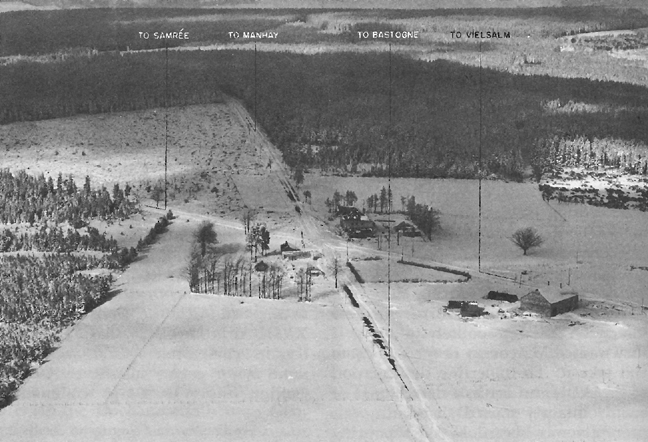
The German Ardennes Offensive began December 16, 1944, along an 80-mile front. Now known as the Battle of the Bulge, it remains the largest battle ever fought by the United States Army. The Germans met with initial success in most parts of their central thrust, spearheaded by Battle Group Peiper. Their plan was for the central thrust (by Sixth SS and Fifth Panzer Armies) to have parallel thrusts to the north (Fifteenth Army) and south (Seventh Army), which would prevent American reinforcements from reaching the flanks of the main thrust toward Antwerp. However, the troops on the northern shoulder held most of their ground, thanks to the efforts of the 99th and 2nd Infantry Divisions. This allowed the U. S. 7th Armored Division to move, on the morning of December 17, from north of Aachen, Germany to the center of the front, at St. Vith, Belgium. St. Vith was an extremely important town. The dense Ardennes forest had few roads that could carry heavy traffic, and what roads there were were canalized by the trees. But St. Vith was the easternmost major crossroads in the path of the central German armies. And St. Vith was the only place along the entire front where a railroad line crossed from Germany into the battle area. It was critically important to the German flow of supplies that they take St. Vith very early in the battle, which was their plan. However, the rapid movement of the 7th Armored Division into St. Vith upset their plans. The 7th Armored Division and attached troops (from the 106th and 28th Infantry Divisions and Combat Command "B" of the 9th Armored Division) created a defense that held up long against German assaults, even as other German units of the two central German armies drove far beyond St. Vith, to the north and south of the defensive perimeter. By December 20, the defenders of St. Vith were, in fact, almost completely surrounded inside an oval-shaped perimeter that was called the "fortified goose egg" -- a salient within a salient. The 7th Armored Division's supply units many miles west of St. Vith were fighting as infantry on a front line that ran east-west instead of north-south. Only a narrow strip connected the fortified goose egg to the rest of the American lines. The 82nd Airborne Division was sent in to protect the eastern part of this strip, from Salm-Chateau/Vielsalm to Trois Ponts. And they did. But there were no committed reinforcements to hold the southwestern end of the strip, where there was a strategically critical crossroads at the place known as Baraque de Fraiture. South of the crossroad, the Germans swept past to the west. To the east, the road ran to Salm-chateau and Vielsalm on the Salm River -- the only way in and out of the fortified goose egg. (Click here to see the web page of the big picture of the defense of this south road.) To the north, the road from Baraque de Fraiture ran through Manhay to the important city of Liège. The critical nature of the crossroad was obvious to all, and by December 19, it's defenders were told that they must hold at all cost. They held against increasingly strong German attacks until December 23, when they were overrun by vastly more numerous forces. Who were these men who held out against so much for so long?
This web page is about the men of the 7th Armored Division and their role in the battle. There are links to other web sites with information about the other units, since no complete understanding of the battle can be had from just one unit's experiences in it. But there has been an absence until now of detailed material about the 7th Armored Division's role in this crucial battle, and this web page is intended to provide that detail. |
203rd Anti-Aircraft Artillery (Automatic Weapons) Battalion Accounts
Note that D/203 was also engaged (with B/203 and elements of 7th Armored Division Trains) in the December 20 action at Samrée (to the west of Baraque de Fraiture), for which there are B/203 combat interviews (which mention D/203). The defense of Samr e should not be overlooked. While the location at Samr e was not as strategically significant as the Baraque de Fraiture crossroads, the defense of the town did have a bearing on the defenders of Baraque de Fraiture.
Note also that D/203 was involved in the December 18 action at Stavelot, Belgium against German Kampfgruppe Peiper, for which there is a separate combat interview.
87th Cavalry Reconnaissance Squadron, Mechanized, Accounts
Note that D/87 was acting separately from the rest of the 87th Cavalry Reconnaissance Battalion, whose units were distributed in different areas of the fortified goose egg, under different commands.
While there are more accounts, these accounts are worth exploring beyond this web page:
Hugh M. Cole's "The Ardennes: Battle of the Bulge"
This is a volume of the official U. S. Army in World War II series. The Center for Military History has put the complete text and the in-text maps on the internet. (Click here for the Table of Contents.)
Here is a complete list of all index references to and maps including Baraque de Fraiture, as live links to the text. NOTE: These links are mostly to the first page of a section, so that you will have to scroll down to the correct page or else use FIND to search for "Baraque".
George Winter's "Manhay The Ardennes Christmas 1944"
Published in 1990 by J. J. Fodorwicz Publishing, this book has long been out of print, and the publisher has no plans for another printing. George Winter contacted survivors on both sides of the battle, at Baraque de Fraiture and at Manhay. He was able to draw a highly detailed colored map, showing the assault by the Germans on December 23 that finally overran the American defense. The book is especially strong on the Baraque de Fraiture accounts by the men of the 643rd Tank Destroyer Battalion. Unfortunately, it has no 7th Armored Division accounts from Baraque de Fraiture, although it has good 7th Armored Division accounts of the later battle for Manhay and Task Force Corbin.
106th Infantry Division's Quarterly "The Cub" article: "Parker's Crossroads: The Alamo Defense" by Sergeant First Class Richard Raymond III USA (Ret) -- web page also contains a 1980 letter from 82nd Airborne Gen. James Gavin to Major Parker
106th Infantry Division Quarterly "The Cub" article: "The 589th Field Artillery Battery's defense of Baraque de Fraiture, 19-23 December, 1944" -- web page with many personal accounts of 589th FA Bn men
CRIBA Photo of Baraque de Fraiture Monument: CRIBA is the Centre de Recherches et d'Informations sur la Bataille des Ardennes (Center of Research and Information on the Battle of the Ardennes). The CRIBA web site contains many accounts of actions in the Bulge, including these on Baraque de Fraiture:
Important Book of Memories of Men Who Were There
The veterans of the 589th Field Artillery Battalion who were at the crossroads combined their written memoirs into a book that is a must for anyone who is researching the battle. While the book is by 589 FAB men, their accounts include important details of the actions and placement of all of the other units who were at the crossroads. The book is titled On the Job Training - The Battle of Parker's Crossroads. Click here to see the complete book on the Internet. To obtain a copy, send a $25 check, payable to: