7th Armored Division Document Repository
World War II Documents of and related to U. S. 7th Armored Division
Bookmark this page as http://www.7thArmdDiv.org/docrep/index.htm
Last updated: January 26. 2026 - What's New?
Click here for an Active Overview of all pages at the Dad's War Web Site
| Finding Aids | Pre-Combat | Aug 44 | Sep 44 | Oct 44 | Nov 44 | Dec 44 |
| Jan 45 | Feb 45 | Mar 45 | Apr 45 | May 45 | Post-Combat | Special | Post-war Memoirs | IMAGES |
| Microsoft Word Viewer | Microsoft Excel Viewer | Adobe PDF File Reader |
|
Toward an Accurate & Complete Record of the 7th Armored Division
It is often said that "those who do not learn the lessons of history are doomed to repeat them". But if what is considered to be "history" is not accurate, then the lessons supposedly learned are not the lessons of history, and the suffering will be repeated. While you can come to the study of history with a hypothesis, you must be willing to alter or abandon that hypothesis if the accurate record proves that hypothesis to be wrong.
If you are coming to "history" with a pre-conceived notion and seeking facts to confirm that notion and to attempt to force-fit the historical record to conform to your preconceived notion, then you are not seeking the truth of history, and you will not learn the lessons of history.
|
7AD Combat Interview Books Now Available on Amazon.com
- Click here for the Amazon web page listing all of books.
- Click here for the main page with the complete lists of all of the combat interview books, including those not yet available on Amazon.
|
About this Site
This is an auxiliary web site to the 7th Armored Division Association web site. This site began as a temporary storage (since my AOL space for 7AD was all consumed) for text-only documents that I (Wesley Johnston) had gathered in my 2004 research trip (6,200+ pages), as part of my effort to find the answers needed to write an accurate WWII combat history of 38th Armored Infantry Battalion. It has since expanded to include some of the 15,000+ pages of documents from my 2005 research trip, records I had obtained before 2004, and records that have been sent to me since the site began. In October 2005, about 15 volunteer 7th Armored Division historians began adding to the transcription effort, so that posting of new documents has accelearated since then.
I began this work in 1994 but have had to drop most or all of it for many years, due to severe health limitations. While my health has improved sufficiently to at least resume a cautious attempt to finally do the research and the writing, this is an immense project. 38 AIB was badly mauled several times during World War II, often losing the officers who knew the most about the events. Thus there are very significant battles for which only very sketchy accounts have existed in prior histories. It has cost me many MANY thousands of dollars and many MANY thousands of hours to try to find the shattered and scattered fragments of what happened in these battles and piece them back together into the accurate story of what happened -- and not settle for sketchy speculations about events that took place and are forever fixed in history, with very real implications for the men who were involved and for their families for the rest of time after those events. We owe it to them to understand the story as accurately as it can now be known, and that is what I am determined to do.
As of May 11, 2009, I added many images to a directory that has thus far been non-public. As of May 11, 2009, that directory is now public. Click here to see the folder of the images that have thus far been uploaded for you to download. You will have to navigate to the image file and then right click on it to download it or left click to open and view it (if you have a viewer - files are PDF, TIF, JPG).
You can find the latest status on the writing of that history by clicking here. For the latest status on my health and my ability to respond to e-mails, follow the "What's New" link at the top of this page. For information about contacting me, click here.
 New 2025 New 2025
(Names in parens are transcribers or sources of material)
Black are transcription documents. Red are images or audio-visual files
Click here for Images folder - then click the Still Images link for still images.
7AD
- Division
- General Orders (converted to single PDF)
- 33rd Armored Engineer Battalion
- Photographs of Capt. Morris Hochberg (B/33) and several other 33 AEB men in Images folder
- 38th Armored Infantry Battalion
- Company A
- Individual Deceased Personnel File of S/Sgt Thomas Alfred Despot (DOW as POW 5 Oct 1944) in Images folder
- Company B
- Individual Deceased Personnel File of T/Sgt John P. George (KIA 18 Dec 1944) in Images folder
- Company C
- Individual Deceased Personnel File of Pfc Frank L. Despot (KIA 6 Sep 1944) in Images folder
- 31st Tank Battalion
- Entire Battalion
- All March 1945 Morning Reports in Images folder
Never before posted but now available from my 2017 trip to St. Louis National Archives branch
- All April 1945 Morning Reports in Images folder
These replace the poorly digitized prior version, thanks to Lori Berdak Miller of Redbird Research (who I highly recommend for any research at the St. Louis branch of the National Archives).
- Company C
- Individual Deceased Personnel File of 1st Lt Rex E. Waldrop (KIA 7 Apr 1945) in Images folder
7AD
- 48th Armored Infantry Battalion
- Company A
- Individual Deceased Personnel File of Cpl Val K. O'Kane (KIA 7 Apr 1945) in Images folder
- Company B
- Individual Deceased Personnel File of Pfc William H. Grady, Jr. (KIA 7 Apr 1945) in Images folder
- Individual Deceased Personnel File of Pvt Robert E. Lee Price (DOW 8 Apr from wounds 7 Apr 1945) in Images folder
- Individual Deceased Personnel File of Pvt John G. White (KIA 7 Apr 1945) in Images folder
- Individual Deceased Personnel File of S/Sgt William H. Zoellner (KIA 7 Apr 1945) in Images folder
- Company C
- Individual Deceased Personnel File of Pfc John J. Lister (KIA 7 Apr 1945) in Images folder
- Individual Deceased Personnel File of Pvt Edward D. Ralston (KIA 7 Apr 1945) in Images folder
- Individual Deceased Personnel File of Pvt Jack T. Remcus (KIA 8 (or maybe 7) Apr 1945) in Images folder
- 87th Cavalry Reconnaissance Squadron
- After Action Report: updated footnote 32
- Troop A
- Individual Deceased Personnel File of T/5 Wildon R. Bailey (KIA 26 Jan 1945) in Images folder
- Troop C
- Individual Deceased Personnel File of Pfc Ode Julius Garner (DNB 6 Jun 1945) in Images folder
NON-7AD
|
| |
|
New 2024
(Names in parens are transcribers or sources of material)
Black are transcription documents. Red are images or audio-visual files
Click here for Images folder - then click the Still Images link for still images.
7AD
- Combat Command A
- Individual Deceased Personnel File of T/5 Jack J. Fisk (KIA 21 Dec 1944) in Images folder
- Individual Deceased Personnel File of 1st Lt. Daniel Jasper Murphy (KIA 21 Dec 1944) in Images folder
- Individual Deceased Personnel File of Sgt. Wilbur F. Woolwright (KIA 21 Dec 1944) in Images folder
- 17th Tank Battalion
- Headquarters Company
- Individual Deceased Personnel File of Pfc. Randolph E. Oswald (KIA 29 Oct 1944) in Images folder
- Company C
- Individual Deceased Personnel File of Cpl. Francis H. Bosch (KIA 4 Oct 1944) in Images folder
- 23rd Armored Infantry Battalion
- Company B
- Individual Deceased Personnel File of Pfc Clyde W. Barnes (KIA 28 Mar 1945) in Images folder
- Company C
- Individual Deceased Personnel File of 1st Lt Edward J Hannabury (KIA 30 Oct 1944) in Images folder
- 31st Tank Battalion
- Company C
- Individual Deceased Personnel File of T/4 Donald R. Bradehoft (KIA 28 Oct 1944) in Images folder
- Individual Deceased Personnel File of Pvt. Carl O. Carlson (KIA 30 Oct 1944) in Images folder
- Individual Deceased Personnel File of Pvt. Bartley S. Cox (KIA 30 Oct 1944) in Images folder
- Company D
- Individual Deceased Personnel File of Pvt. La Verne G. Cook (KIA 27 Oct 1944) in Images folder
- 38th Armored Infantry Battalion
- Company B
- Individual Deceased Personnel File of Pvt. Paul Grey Blankenship (KIA 7 Oct 1944) in Images folder
- Individual Deceased Personnel File of Pfc. John Fremon Baker (KIA 21 Dec 1944) in Images folder
7AD
- 48th Armored Infantry Battalion
- Headquarters Company
- Individual Deceased Personnel File of Pfc John Bevalaqua (KIA 26 Dec 1944) in Images folder
- Individual Deceased Personnel File of Sgt Milton E. Fein (KIA 22 Dec 1944) in Images folder
- Company A
- Individual Deceased Personnel File of T/Sgt James H. Adams (KIA 20 Sep 1944) in Images folder
- Individual Deceased Personnel File of Sgt Joe S. Renfrow (KIA 7 Sep 1944) in Images folder
- Company B
- Individual Deceased Personnel File of Pfc. Albert Clouse (KIA 22 Sep 1944) in Images folder
- Individual Deceased Personnel File of Pfc. Terrence M. Coyne (KIA 8 Apr 1945) in Images folder
- Individual Deceased Personnel File of Pvt. Joseph A. Scheurich (KIA 22 Sep 1944) in Images folder
- 87th Cavalry Reconnaissance Squadron
- Troop B
- Individual Deceased Personnel File of Pfc Fred H. Bradburn (DOW 14 Sep 1944) in Images folder
- Individual Deceased Personnel File of T/5 Elmo Brownlee (DOW 2 Oct 1944) in Images folder
- 489th Armored Field Artillery Battalion
- Battery C
- Individual Deceased Personnel File of 2d Lt Donald R. Bauer (KIA 23 Dec 1944) in Images folder
- 814th Tank Destroyer Battalion
- Company A
- Individual Deceased Personnel File of Cpl Hallie A. Adams (KIA 22 Sep 1944) in Images folder
- Individual Deceased Personnel File of T/5 William J. Baldus (KIA 22 Sep 1944) in Images folder
- Individual Deceased Personnel File of Sgt Dossie M. Goff (KIA 22 Sep 1944) in Images folder
- Company B
- Individual Deceased Personnel File of Pvt Fred Wayt (KIA 29 Oct 1944) in Images folder
NON-7AD
- 5th Infantry Division
- Combat Interviews of the Moselle River Crossing currently only in Dornot Bridgehead web page as work in progress
|
| |
|
The Documents and How to Use Them Best
CAVEAT: The bulk of the information that is on the 7th Armored Division web pages has arisen from the records and the 10+ years of expertise that I have garnered during the search for the history of 38 AIB. I have published indexed and annotated accounts of some of those records, since people have asked me to at least do that much prior to the writing of the history of 38 AIB. (They also wanted to contribute to the effort, and this allowed them to contribute in a way that they also had something for it.) The introductions and annotations that I have added to those publications are required for most people, in order to be able to understand and to place into context -- and even to correct errors in -- what the records are saying. In other words, the introductions and annotations are necessary to make accurate sense of the records. The records presented on this auxiliary web site do NOT include any such introductions and annotations. These are the raw transcriptions (with a very few grammatical or spelling corrections in some rare cases) of the original records. I have hesitated to do this sort of publication of raw documents, since they can easily be mis-interpreted and lead people to seriously wrong conclusions, if they are not placed within the context of all else that is known about the events and if they are not evaluated within the overall context, which may show that some of what they report was in error.
If you do not have Microsoft Word or Excel, then you will need to download and install the Microsoft Word Viewer and the Microsoft Excel Viewer in order to be able to read the Word documents or the Excel spreadsheets with the Morning Report information. (Click on the words "Microsoft Word Viewer" or "Microsoft Excel Viewer" in the previous sentence to follow the links to download and install the software.) There are a few links to external PDF files. You need to have Adobe PDF File Reader to read the PDF files.
The organization has grown a bit muddy as the flood of new documents being added has increased. I originally had a sharp distinction between primary and secondary records. That was muddied by official and non-official documents written shortly after the period, such as the March 1945 Unit History of 31st Tank Battalion or the immediate-post-war history of the 203rd Anti-Aircraft Artillery Battalion. At this time, the priority is on transcribing and posting as many records as possible while veterans are still alive to answer the questions that arise from the documents. So someday, I do need to go over the organizational structure with an eye to primary vs. secondary sources. But that someday has not yet arrived, and the efforts on this site continue to be focused on the rapid posting of accurate transcripts.
How to Search the List of Documents
The documents exist in single copies, mostly as Microsoft Word documents. A footnote or other notice at the beginning of each document tells where the original is held and how to locate it there. This is a repository, plain and simple. So, I am not going to make this a very sophisticated site. All of the records are listed below by month. My first concentration is on France, which means August and September 1944. Second concentration is combat in Holland, September-November 1944. But other records are also included for later (and a few earlier) events. If you are looking for a specific unit, the sub-groupings are by unit. So either scroll down or use your browser's FIND function to search for the unit, and if you do not find it, look for the unit to which it was attached. Once you are in a document, use your browser's BACK button to return to this page. (The numbers in parentheses after each document are the file sizes. Larger files will take longer to download.)
|
Making the Most of the Documents for a Specific Company or Battalion
If you are researching a specific battalion, one of the biggest mistakes that you can make is to read only the documents for that battalion.
The battalions were always attached to other units, usually one or more of the three Combat Commands or sometimes to a Task Force within one of the Combat Commands or sometimes to a unit outside of 7th Armored Division. For example, the most common configuration of one of the Combat Commands was to have attached one of the three artillery battalions, one of the three armored infantry battalions, and one of the three tank battalions, as well as a company of the engineer battalion, a troop of the reconnaissance squadron and a company of the tank destroyer battalion. Thus the reports of the Combat Command as well as those of any of the other battalions attached to the same Combat Command are very likely to contain references to the specific battalion for which you are seeking information.
In particular, the After Action Reports of the artillery units are very comprehensive. Often they are better records of what the Combat Command -- and any of the elements attached to the Combat Command -- was doing than are the reports of the Combat Command.
And the artillery reports are sometimes even more informative about another battalion than that battalion's own reports are. For example, the January 1945 38th Armored Infantry Battalion's After Action Report of 21 January 1945 makes no reference to the fact (as the 434th Armored Field Artillery Battalion's After Action Report does tell) that while 38 AIB was attached that day to CCR, C/38 was attached to CCB and moved to a location south of Born, Belgium.
So the bottom line is that if you want to really know what a specific company or battalion was doing, do the following:
- Read that battalion's reports (and that company's reports, if there are any shown)
- Establish which Combat Commands and/or Task Forces and/or other units that the company or battalion was attached to for the period of your interest.
- Read the reports of those other units. Even if they do not specifically mention the specific company or battalion for which you are looking, they are describing the events that included that company or battalion.
Finally, be careful to watch for attachments of individual squads or platoons to other elements than the rest of the company. These were rare, but they did happen.
|
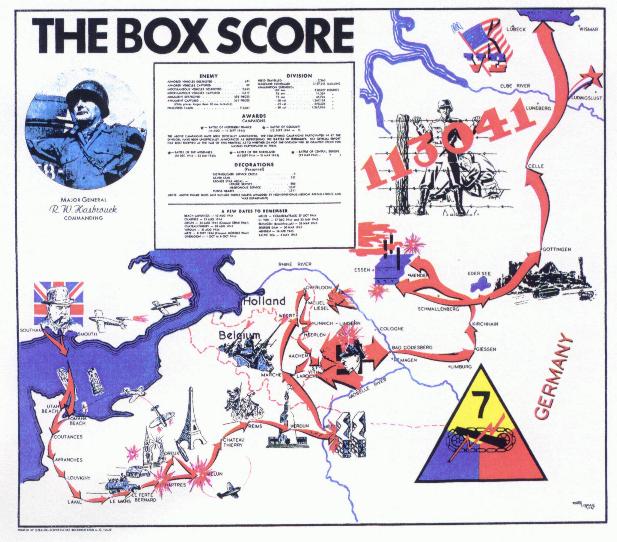
To help with putting together where they were and when, please use the map and brief chronology below to figure out which month(s) you want to read about.
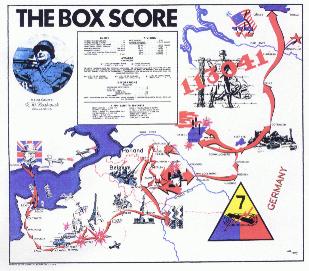
Click on the map for a larger version (77K JPG).
| Finding Aids | Pre-Combat | Aug 44 | Sep 44 | Oct 44 | Nov 44 | Dec 44 |
| Jan 45 | Feb 45 | Post-Feb 45 | Special | Post-war Memoirs |
- Pre-Combat: Training in the States
- August 1944 - France: Chartres (16-18), Melun (22-25), Verdun
- September 1944 - France & Holland: Metz area (1-25), Overloon (30)
- October 1944 - Holland: Overloon (1-7), Meijel (27-31)
- November 1944 - Holland & Germany: Meijel (1-7), Germany (28)
- December 1944 - Germany & Belgium: Setterich (1-5), St. Vith (17-22), Manhay-Grandmenil (24-31)
- January 1945 - Belgium: Return to St. Vith (15-28)
- February 1945 - Germany & Belgium: Strauch, Road Building at Stavelot & Elsenborn
- March 1945 - Germany: Move to the Rhine, Rhine Crossing (24-25), Encirclement of Ruhr Pocket & Capture of Edersee Dam (25-30)
- April 1945 - Germany: Reduction of the Ruhr Pocket (1-17), Move to the Baltic Sea
Many Document Images Now Available
Since we now have virtually unlimited web space since May 2008, many of the images of documents are now included in the Images folder. Click on the "Images" link at the top of this page, under the 7th Armored Division patch, to go to the main page of the images. Even though many of these files are transcribed into searchable text files (below on this page), these transcribed files do not contain the maps, overlays, and photographs that are included in many of the original records. But all of those images are included in the Images folder. In addition, the Images folder contains the images of a great many documents that are not included among the transcriptions on this page.
Finding Aids - National Archives Finding Aids and How To
The National Archives has created a number of Finding Aids for their records on World War II. The main purpose of these Finding Aids is to know what codes to use and which boxes to use on a "pull" order, which is the order that you write to instruct the Archives as to which boxes that you want them to pull from the storage shelves for you to examine in the reading room. I have copied and transcribed the following Finding Aids.
The National Archives web site also has a page on World War II National Archives Finding Aids. In particular, the National Archives Reference Information Papers (RIPs) include several that are very deep on WWII material. Some of the WWII RIPs are online -- but not all of them; click here for the complete list of all of the NARA RIPs, WWII and other.
I have written a separate web page on How to Conduct Effective Research on WWII Unit Records at National Archives II.
How To - National Personnel Records Center (St. Louis)
I have written a separate web page on How to Find WWII Morning Reports at the National Personnel Records Center which is now under the National Archives.
Finding Aids - Military History Institute Finding Aids
The Military History Institute (Carlisle, PA) has many collections, including the Hatlem Collection of aerial photographs of European battle sites made in the late 1940's. The aerial photos in the green books (the Center of Military History's official series of hsitories of the U. S. Army in World War II) are from the Hatlem Collection. The collection is being digitized, and a new finding aid may be created. The fragmentary finding aid below is an Excel spreadsheet transcription of most of the index for France, taken from the old index.
Other Finding Aids
Before 1944-08 (August 1944) - Prior to Combat
Activated March 1, 1942 at Camp Polk, Louisiana, the 7th Armored Division took part in Louisiana Maneuvers (along the Texas-Louisiana border), went to Camp Coxcomb for desert training in California, returned east to Fort Benning in Georgia, and then traveled north to await transport, finally boarding the Queen Mary at New York on June 6, 1944. They sailed to Scotland, went by train to Tidworth Barracks in Wiltshire, England, and then in August 1944 crossed the English Channel to go ashore on the former invasion beaches -- Utah and Omaha -- in France.
The original organization of the Division was changed on September 20, 1943. The diagram below shows how the reorganization transformed the original organization into the organization that the Division used for the remainder of its existence.
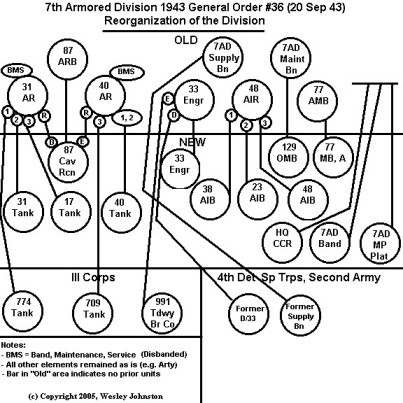
- 7th Armored Division
- Division Level and Division-Wide
- General Orders of 7th Armored Division Headquarters
The General Orders most often detail with awards, though they also include Div HQ personnel changes and general announcements. Thus there are many names of individuals in the General Orders. The General Orders were numbered in sequence, starting over at 1 at the start of each year.
- Special Orders of 7th Armored Division Headquarters (202K - 28 pages, plus 4 introductory and 1 appendix pages) - The Special Orders most often detail the assignment of individual soldiers to units of the Division. Thus all elements of the Division appeared in the Special Orders, though any given Special Order would probably only include some of the elements. The Special Orders were numbered in sequence, starting over at 1 at the start of each year.
SEE ALSO Ninth US Army General Orders, for 7AD Distinguished Service Cross citations. At this time, only a few special orders have been found, some with pages missing.
- Administrative Memoranda of 7th Armored Division Headquarters (32K - 1 page, plus introductory page) - at this time only 1942 AM #4 has been found -- See the Images folder for the image of the original.
- Division Trains
- Supply Battalion
- Chaplains
- Military Police Platoon (MP Platoon)
- Division Band
- "Off Limits" Playbill (7.4MB - 20 pages [10 PDF images]) - 7AD play probably performed in 1943 by Division members
- "7th Armored Backs Attack With Big Loan" - 30 Sep 1943 Benning Bayonet article
- 17th Tank Battalion
- 23rd Armored Infantry Battalion
- 31st Armored Regiment (existed prior to 20 September 1943; see also 31st Tank Battalion)
- 31st Tank Battalion (see also 31st Armored Regiment)
- 33rd Armored Engineer Battalion
- 38th Armored Infantry Battalion
- 40th Tank Battalion
- 48th Armored Infantry Regiment (existed prior to 20 September 1943)
See the Armored Infantry Battalion that it became:
- 1st Battalion (companies A, B, C) became 38th Armored Infantry Battalion (companies A, B, C)
- 2nd Battalion (companies D, E, F) became 23rd Armored Infantry Battalion (companies A, B, C)
- 3rd Battalion (companies G, H, I) became 48th Armored Infantry Battalion (companies A, B, C)
- 87th Cavalry Reconnaissance Squadron (Mechanized)
- 129th Armored Ordnance Maintenance Battalion
- 203rd Anti-aircraft Artillery (Automatic Weapons) Battalion
- 434th Armored Field Artillery Battalion
- 434 AFAB "Record of Operations" (58K - 9 pages)
- William Sheveland Collection The link is to the introductory document about the collection. Bill Sheveland commanded Service Battery. There are no great accounts here, but there are many names and addresses of men of the 434th. The collection consists of four PDF files, which can be viewed by clicking here.
- 446th Quartermaster Troop Transport Company
Note that the dump types referred to are Class I (food), Class II (clothing and equipment), Class III (petroleum), and Class IV (general supplies).
- 3967th Quartermaster Truck Company
Note that the dump types referred to are Class I (food), Class II (clothing and equipment), Class III (petroleum), and Class IV (general supplies).
- Other than 7th Armored Division
- 15th Armored Group
- 774th Tank Battalion (spun off from 7AD 20 Sep 1943)
1944-08 (August 1944) - England, Channel, France
In August 1944, 7AD moved from Tidworth Barracks in England to the Marshaling Area and then boarded landing ships at Southampton and sailed to France. The men and equipment came ashore on both Omaha and Utah Beaches, spread over nearly a week. I know that HQ CCA landed 10 August and that 38 AIB landed 11 and 12 August (11 Aug: Bn HQ, Sv Co, C Co; 12 Aug: HQ Co, A Co, B Co; Not yet known: Med Det). The initial plans for the Division had to be changed, since it took so long to unload the men and equipment and assemlble the Division. Ultimately, the Division went into combat attached to XX Corps (along with 5th Infantry Division), which was attached to Third U. S. Army. The Division's major combat sites during the month were at Chartres (15-18), Melun (22-25) and then in places all along a rapid drive to Verdun. There was a brief period south of Dreux, after the liberation of Chartres.
SPECIAL NOTES FOR AUGUST:
I have compiled many 7AD documents into a fully indexed and annotated book, with an introduction that contains nine original maps, which I created from the information in the documents. Click here for more information.
I have compiled, annotated, indexed and written an introduction for several 7th Armored Division Hospital Interviews that cover August-September 1944. Click here for more information.
http://www.7tharmddiv.org/docrep/images/7AD/Wartime%20Publications/From-the-Beaches-to-the-Baltic.pdf
- 7th Armored Division
- Division Level and Division-Wide
- 7th Armored Division After Action Report for August 1944 (76K - 17 pages)
- "From the Beaches to the Baltic: The Story of the 7th Armored Division" (immediate post-war history, published by the Division) (190K - 69 pages, plus one introductory page) PDF File of Original Images of the booklet
- "Roll Out the Barrel" (Fall 1944 7th Armored Division publication) PDF File of Original Images of the booklet
- VIDEO Lt. Gen. George S. Patton visits 7th Armored Division 26 August 1944 Film # 111-ADC-2225 Total Time 0:59 (2.6 MB) - no sound; image quality is not good
- 7th Armored Division General Orders
The General Orders were numbered in sequence, starting over at 1 at the start of each year.
SEE ALSO Ninth US Army General Orders, for 7AD Distinguished Service Cross citations.
Most GO's list awards, so that there are many names.
Award GO's refer to prior events. So check all GO's on or after the date of your interest.
These are big files. So expect to wait longer for them to download.
- 7th Armored Division Headquarters
- Morning Report Stations and Record of Events - [Excel spreadsheet] contains station (location -- underlined) and occasional Record of Events entries (preceded by a slash [/]) for those Morning Reports thus far abstracted
- G-1
- G-3 (Operations)
- Division Artillery
- Division Quartermaster
Note that the dump types referred to are Class I (food), Class II (clothing and equipment), Class III (petroleum), and Class IV (general supplies).
- Division Trains
- After Action Report (138K - 27 pages, plus 1 introductory page) - missing September 1944 but December 1944 report includes September 1944 stations and marches
- Unit History (370K - 62 pages, plus 1 introductory page)
- Military Police Platoon (MP Platoon)
- Division Band
- Combat Command "A"
- Combat Command "B"
- Combat Command "R"
- 17th Tank Battalion
- 23rd Armored Infantry Battalion
- 31st Tank Battalion
- 33rd Armored Engineer Battalion
- 38th Armored Infantry Battalion
- 40th Tank Battalion
- 48th Armored Infantry Battalion
- 77th Armored Medical Battalion
- 87th Cavalry Reconnaissance Squadron (Mechanized)
- 129th Armored Ordnance Maintenance Battalion
- 147th Signal Company
- 203rd Anti-aircraft Artillery (Automatic Weapons) Battalion
- 434th Armored Field Artillery Battalion
- 440th Armored Field Artillery Battalion
- 446th Quartermaster Troop Transport Company
Note that the dump types referred to are Class I (food), Class II (clothing and equipment), Class III (petroleum), and Class IV (general supplies).
- 489th Armored Field Artillery Battalion
- 3967th Quartermaster Truck Company
Note that the dump types referred to are Class I (food), Class II (clothing and equipment), Class III (petroleum), and Class IV (general supplies).
- Other than 7th Armored Division
- 3rd Cavalry Group (3rd Cavalry Reconnaissance Squadron, 43rd Cavalry Reconnaissance Squadron)
- Ninth U.S. Army (NUSA)
- NUSA General Orders (80K - 6 pages, plus 1 introductory page) - contain most of the Distinguished Service Cross citations awarded to men of 7th Armored Division
- XX Corps
- 774th Tank Battalion (spun off from 7AD 20 Sep 1943)
- Army Pamphlets, Booklets and Manuals
1944-09 (September 1944) - France, Belgium, Holland
Most of September was in France, under XX Corps. A feint to the north was made in early September, but the combat from 6-25 September was all focused on the area around Metz, with extremely heavy casualties. Following the failure of Operation Market-Garden in Holland (made famous in the book and movie "A Bridge Too Far", the Allies had to defend a long salient. So 7th Armored Division left France and XX Corps on 25 September to move north through Belgium into Holland, to protect the right (east) flank of the salient. From 25 September and for the rest of the month, 7AD was transferred to XIX Corps, First U. S. Army. The first combat began with an attack by CCA at Overloon, Holland.
SPECIAL NOTES FOR SEPTEMBER:
I have compiled, annotated, indexed and written an introduction for several 7th Armored Division Hospital Interviews that cover August-September 1944. Click here for more information.
- War-time Sources
- 7th Armored Division
- Division Level and Division-Wide
- 7th Armored Division After Action Report for September 1944 (76K - 25 pages)
- Post-war records
- "Roll Out the Barrel" (Fall 1944 7th Armored Division publication) PDF File of Original Images of the booklet
- 7th Armored Division General Orders
The General Orders were numbered in sequence, starting over at 1 at the start of each year.
SEE ALSO Ninth US Army General Orders, for 7AD Distinguished Service Cross citations.
Most GO's list awards, so that there are many names.
Award GO's refer to prior events. So check all GO's on or after the date of your interest.
These are big files. So expect to wait longer for them to download.
- Special Orders of 7th Armored Division Headquarters (202K - 28 pages, plus 4 introductory and 1 appendix pages) - The Special Orders most often detail the assignment of individual soldiers to units of the Division. Thus all elements of the Division appeared in the Special Orders, though any given Special Order would probably only include some of the elements. The Special Orders were numbered in sequence, starting over at 1 at the start of each year.
SEE ALSO Ninth US Army General Orders, for 7AD Distinguished Service Cross citations. At this time, only a few special orders have been found, some with pages missing.
- 7th Armored Division Headquarters
- Morning Report Stations and Record of Events - [Excel spreadsheet] contains station (location -- underlined) and occasional Record of Events entries (preceded by a slash [/]) for those Morning Reports thus far abstracted
- G-1
- G-2 (Intelligence)
- Division Artillery
- Division Quartermaster
Note that the dump types referred to are Class I (food), Class II (clothing and equipment), Class III (petroleum), and Class IV (general supplies).
- Division Trains
- After Action Report (138K - 27 pages, plus 1 introductory page) - missing September 1944 but December 1944 report includes September 1944 stations and marches
- Unit History (370K - 62 pages, plus 1 introductory page)
- Military Police Platoon (MP Platoon)
- Division Band
- Combat Command "A"
- Combat Command "B"
- Combat Command "R"
- 17th Tank Battalion
- 23rd Armored Infantry Battalion
- 31st Tank Battalion
- 33rd Armored Engineer Battalion
- 38th Armored Infantry Battalion
- 40th Tank Battalion
- 48th Armored Infantry Battalion
- 77th Armored Medical Battalion
- 87th Cavalry Reconnaissance Squadron (Mechanized)
- 129th Armored Ordnance Maintenance Battalion
- 147th Signal Company
- 203rd Anti-aircraft Artillery (Automatic Weapons) Battalion
- 434th Armored Field Artillery Battalion
- 440th Armored Field Artillery Battalion
- 446th Quartermaster Troop Transport Company
Note that the dump types referred to are Class I (food), Class II (clothing and equipment), Class III (petroleum), and Class IV (general supplies).
- 489th Armored Field Artillery Battalion
- 814th Tank Destroyer Battalion (attached throughout combat; not organic to 7AD)
- 3967th Quartermaster Truck Company
Note that the dump types referred to are Class I (food), Class II (clothing and equipment), Class III (petroleum), and Class IV (general supplies).
- Other than 7th Armored Division
- 3rd Cavalry Group (3rd Cavalry Reconnaissance Squadron, 43rd Cavalry Reconnaissance Squadron)
- Ninth U.S. Army (NUSA)
- NUSA General Orders (80K - 6 pages, plus 1 introductory page) - contain most of the Distinguished Service Cross citations awarded to men of 7th Armored Division
- XX Corps
- 774th Tank Battalion (spun off from 7AD 20 Sep 1943)
- German
- Interview of Genoberst. Johannes Blaskowitz, commander of the Metz defense until 1 October 1944: Defense of Metz (35K - 2 pages, plus 1 introductory page) - This is an extraordinary document, in which he is asked point blank about the pet American theories/beliefs about Metz that still are held and believed many decades later, even though he had clearly laid them to rest in this 1945 interview.
- Fahnenjunkerschule VI: Defense of Metz, 2-24 September 1944 (38 page transcription) - Images
- 462nd Replacement Division: Defense of Metz, 1-8 September 1944 (85K - 16 pages, plus 3 introductory pages) - Foreign Military Studies manuscript B-042, written by Generalleutnant Walter Krause in 1946
Images of original versions (PDF files)
Post-war Sources
- Secondary Post-War Sources
- "The Peel Marshes" (90K - 20 pages [18 of original, plus 2 added]) - Chapter 10 of Charles B. MacDonald's 1961 volume "The Siegfried Line Campaign" in the US Army Center of Military History's "U. S. Army in World War II" series (the green books), covering the period 29 September - 3 December 1944, of which 7th Armored Division combat was 30 September - 7 November 1944
1944-10 (October 1944) - Holland
October began with the continuing attacks by the Division at Overloon, which continued back and forth until 7 October, with heavy casualties. The Division then moved from XIX Corps, First U. S. Army to VIII Corps, Second British Army, where they remained for the rest of the month. Combat was engaged with attacks by Division elements (including 38 AIB) at Griendtsveen. The Division then went into a defensive role west of Meijel. It was through Meijel that the Germans launched a large counter-attack on 28 October, which began fierce combat that lasted into November, with heavy casualties.
NOTE: There are very significant post-war studies included for this month. Either click here or scroll down past the specific units to see these studies.
Click on the map for a large map (601K) showing the coordinate grid for the Meijel-Weert-Deurne area of the Netherlands (in provinces of Noord Brabant and Limburg).
 Many of the documents listed below for this month make references to grid coordinates that can be precisely located using this map. The map has vertical (East-West) grid lines from 94 to 00 to 21 and horizontal (North-South) grid lines from 55 to 75.
|
|
Click here for a special page about the 7AD tanks lost at Overloon.
|
- War-time Sources
- 7th Armored Division
- Division Level and Division-Wide
- 7th Armored Division After Action Report for October 1944 (107K - 30 pages)
- "Battle of Canals" 27 October - 7 November 1944 at and near Meijel, Holland
This is a narrative account written shortly after the events by Lt. Robert E. Merriam, based on extensive documents and interviews gathered at the time of the events. It includes very specific references to almost all combat elements of the Division.
- "From the Beaches to the Baltic: The Story of the 7th Armored Division" (immediate post-war history, published by the Division) (190K - 69 pages, plus one introductory page) PDF File of Original Images of the booklet
- 7th Armored Division General Orders
The General Orders were numbered in sequence, starting over at 1 at the start of each year.
SEE ALSO Ninth US Army General Orders, for 7AD Distinguished Service Cross citations.
Most GO's list awards, so that there are many names.
Award GO's refer to prior events. So check all GO's on or after the date of your interest.
These are big files. So expect to wait longer for them to download.
- Special Orders of 7th Armored Division Headquarters (202K - 26 pages, plus 4 introductory and 1 appendix pages) - The Special Orders most often detail the assignment of individual soldiers to units of the Division. Thus all elements of the Division appeared in the Special Orders, though any given Special Order would probably only include some of the elements. The Special Orders were numbered in sequence, starting over at 1 at the start of each year.
SEE ALSO Ninth US Army General Orders, for 7AD Distinguished Service Cross citations. At this time, only a few special orders have been found, some with pages missing.
- 7th Armored Division Headquarters
- Morning Report Stations and Record of Events - [Excel spreadsheet] contains station (location -- underlined) and occasional Record of Events entries (preceded by a slash [/]) for those Morning Reports thus far abstracted
- G-2 (Intelligence)
- G-3 (Operations)
- Division Artillery
- Division Quartermaster
Note that the dump types referred to are Class I (food), Class II (clothing and equipment), Class III (petroleum), and Class IV (general supplies).
- Journal (58K - 6 pages, plus introductory page)
- Division Trains
- After Action Report (138K - 27 pages, plus 1 introductory page) - missing September 1944 but December 1944 report includes September 1944 stations and marches
- Unit History (370K - 62 pages, plus 1 introductory page)
- Military Police Platoon (MP Platoon)
- Division Band
- Post-war records
- Combat Command "A"
- Combat Command "B"
- Combat Command "R"
- 17th Tank Battalion
- 23rd Armored Infantry Battalion
- 31st Tank Battalion
- 33rd Armored Engineer Battalion
- 38th Armored Infantry Battalion
- 40th Tank Battalion
- 48th Armored Infantry Battalion
- 77th Armored Medical Battalion
- 87th Cavalry Reconnaissance Squadron (Mechanized)
- 129th Armored Ordnance Maintenance Battalion
- 147th Signal Company
- 203rd Anti-aircraft Artillery (Automatic Weapons) Battalion
- 434th Armored Field Artillery Battalion
- 440th Armored Field Artillery Battalion
- 446th Quartermaster Troop Transport Company
Note that the dump types referred to are Class I (food), Class II (clothing and equipment), Class III (petroleum), and Class IV (general supplies).
- 489th Armored Field Artillery Battalion
- 814th Tank Destroyer Battalion (attached throughout combat; not organic to 7AD)
- 3967th Quartermaster Truck Company
Note that the dump types referred to are Class I (food), Class II (clothing and equipment), Class III (petroleum), and Class IV (general supplies).
- Other than 7th Armored Division
- Ninth U.S. Army (NUSA)
- NUSA General Orders (80K - 6 pages, plus 1 introductory page) - contain most of the Distinguished Service Cross citations awarded to men of 7th Armored Division
- XX Corps
- 24th Evacuation Hospital
- Patient Lists from October 1944 Morning Reports (includes 7AD Casualties at Overloon): The indexing of this list of 3,586 daily patient entries into a spreadsheet was very tedious work, for which we can all thank Lorraine Snipas, daughter of C/38 veteran Tony Snipas. The patients were Overloon casualties of 7AD and 82nd Engineer Combat Battalion in early and mid October, as well as nearby Holland mid-to-late October casualties of 82nd Airborne Division and 101st Airborne Division. Some men had entries on multiple days and thus appear more than once.
When you find an entry, use the PDF page and line number to see the original images in a PDF file. (96MB - takes a bit of time to download; so be patient)
There are several things to keep in mind when viewing the index.
- Question marks, xxx's, and red text indicate difficulty reading the original. Check the original image in the PDF file to make your own reading.
- The index columns in yellow are not in the original images.
- PDF page and line columns allow you to easily find the image in the PDF file.
- The "X out" column contains an "X" when an entry in the original was crossed out.
- The Status column was in the original but not as an entry for every man. The men were grouped by status. They were distinguished as Officers (O) and Enlisted Men (EM). They were mostly shown either as Sick (which included wounded men and those who were sick from other causes) or Evac (evacuated to another hospital). There are also some Deceased entries.
- There are three worksheet within the spreadsheet. Since many entries were difficult to read, check all three worksheets for any specific individual to be sure to find all of his entries.
- List order [order in the images and in the PDF file]
- Name order
- ASN (Army Service Number) order
- British 25th Field Regiment (Artillery)
- 774th Tank Battalion (separate) [spun off from 7AD 20 Sep 1943]
Post-war Sources
- Secondary Post-War Sources
- "The Peel Marshes" (90K - 20 pages [18 of original, plus 2 added]) - Chapter 10 of Charles B. MacDonald's 1961 volume "The Siegfried Line Campaign" in the US Army Center of Military History's "U. S. Army in World War II" series (the green books), covering the period 29 September - 3 December 1944, of which 7th Armored Division combat was 30 September - 7 November 1944
- "Surprise Attack in the Peel Marshes" (65K - 11 pages, plus introductory page) - This study was prepared in 1953 by OCMH researcher Lucian Heichler "to complement" Charles B. MacDonald's volume "The Siegrfried Line Campaign" and is referenced in that volume in footnote 27 of Chapter 10 on page 243. It is a study of the German point of view on their counter-attack that began 27 October in the Nederweert-Meijel-Liesel area of the Netherlands. It relies heavily on captured German records and on post-war interviews of German officers, especially Gen. Luttewitz, who commanded the German XXXXVII Corps that made the attack.
- "7th Armored Division in Defense of a Canal Line" (63K - 31 pages) - 1948 study at the U. S. Army Armor School - Covers 27-29 October 1944 in area west of Meijel, Holland, as well as a few days before and after
1944-11 (November 1944) - Holland, Germany
November began with a new Division commander: Gen. Hasbrocuk assumed command of the relieved Gen. Silvester, as of 2400 on 31 October. The fierce German counter-attack through Meijel continued. The Division remained in combat, suffering heavy casualties, until November 7, when relieved by British and Scottish troops. The Division then became part of Ninth U. S. Army, XIII Corps, on 9 November 1944. The Division, which had suffered maulings in September, October and November, had many new replacements, so that extensive reorganization and retraining were undertaken during the rest of November, as they remained out of combat in southeastern Holland. Some elements of the Division crossed into Germany on 28 November, to bivouac at Ubach, north of Aachen, as the Division prepared for new attacks in December.
NOTE: There are very significant post-war studies included for the combat in Holland for this month. Either click here or scroll down past the specific units to see these studies.
|
Click on the map for a large map (601K) showing the coordinate grid for the Meijel-Weert-Deurne area of the Netherlands (in provinces of Noord Brabant and Limburg).
Many of the documents listed below for this month make references to grid coordinates that can be precisely located using this map. The map has vertical (East-West) grid lines from 94 to 00 to 21 and horizontal (North-South) grid lines from 55 to 75.
|
- War-time Sources
- 7th Armored Division
- Division Level and Division-Wide
- 7th Armored Division After Action Report for November 1944 (109K - 25 pages)
- "Battle of Canals" 27 October - 7 November 1944 at and near Meijel, Holland
This is a narrative account written shortly after the events by Lt. Robert E. Merriam, based on extensive documents and interviews gathered at the time of the events. It includes very specific references to almost all combat elements of the Division.
- "From the Beaches to the Baltic: The Story of the 7th Armored Division" (immediate post-war history, published by the Division) (190K - 69 pages, plus one introductory page) PDF File of Original Images of the booklet
- 7th Armored Division General Orders
The General Orders were numbered in sequence, starting over at 1 at the start of each year.
SEE ALSO Ninth US Army General Orders, for 7AD Distinguished Service Cross citations.
Most GO's list awards, so that there are many names.
Award GO's refer to prior events. So check all GO's on or after the date of your interest.
These are big files. So expect to wait longer for them to download.
- 7th Armored Division Headquarters
- Morning Report Stations and Record of Events - [Excel spreadsheet] contains station (location -- underlined) and occasional Record of Events entries (preceded by a slash [/]) for those Morning Reports thus far abstracted
- G-2 (Intelligence)
- G-3 (Operations)
- Division Artillery
- Division Trains
- After Action Report (138K - 27 pages, plus 1 introductory page) - missing September 1944 but December 1944 report includes September 1944 stations and marches
- Unit History (370K - 62 pages, plus 1 introductory page)
- Journal (325K - 49 pages, plus 2 introductory pages)
- Military Police Platoon (MP Platoon)
- Division Band
- Combat Command "A"
- Combat Command "B"
- Combat Command "R"
- 17th Tank Battalion
- 23rd Armored Infantry Battalion
- 31st Tank Battalion
- 33rd Armored Engineer Battalion
- 38th Armored Infantry Battalion
- 40th Tank Battalion
- 48th Armored Infantry Battalion
- 77th Armored Medical Battalion
- 87th Cavalry Reconnaissance Squadron (Mechanized)
- 129th Armored Ordnance Maintenance Battalion
- 147th Signal Company
- 203rd Anti-aircraft Artillery (Automatic Weapons) Battalion
- 434th Armored Field Artillery Battalion
- 440th Armored Field Artillery Battalion
- 446th Quartermaster Troop Transport Company
Note that the dump types referred to are Class I (food), Class II (clothing and equipment), Class III (petroleum), and Class IV (general supplies).
- 489th Armored Field Artillery Battalion
- 814th Tank Destroyer Battalion (attached throughout combat; not organic to 7AD)
- 3967th Quartermaster Truck Company
Note that the dump types referred to are Class I (food), Class II (clothing and equipment), Class III (petroleum), and Class IV (general supplies).
- Other than 7th Armored Division
- Ninth U.S. Army (NUSA)
- NUSA General Orders (80K - 6 pages, plus 1 introductory page) - contain most of the Distinguished Service Cross citations awarded to men of 7th Armored Division
- XX Corps
- 774th Tank Battalion (spun off from 7AD 20 Sep 1943)
- Post-war Sources
- Secondary Post-War Sources
- "The Peel Marshes" (90K - 20 pages [18 of original, plus 2 added]) - Chapter 10 of Charles B. MacDonald's 1961 volume "The Siegfried Line Campaign" in the US Army Center of Military History's "U. S. Army in World War II" series (the green books), covering the period 29 September - 3 December 1944, of which 7th Armored Division combat was 30 September - 7 November 1944
1944-12 (December 1944) - Holland, Germany, Belgium
December began with the units of 7th Armored Division out of combat, on both sides of the Dutch-German border, with Ubach, Germany as the east end, which is where 38 AIB was. 7AD was attached to XIII Corps, Ninth U. S. Army. 38 AIB moved up for combat at Setterich and Leitferth, Germany (2-7) and then back to Ubach. At least C/38 was attached to the 334th Infantry Regiment of 84th Infantry Division during the time at Setterich and Leitferth. On 17 December, the Division moved south in two columns to the Vielsalm-St. Vith area of Belgium, where they were in combat until 23 December, during which they were under VIII Corps (along with 106th Infantry Division and elements of 9th Armored Division, 28th Infantry Division and other units), First U. S. Army and then under XVIII Airborne Corps (along with 82nd Airborne Division and 106ht Infantry Division), First U. S. Army. After pulling back from the Vielsalm-St. Vith area, the Division saw combat in the Grandmenil-Manhay-Malempr area (24-29), before being pulled north for reorganization, still under XVIII Airborne Corps, First U. S. Army.
SPECIAL NOTES FOR DECEMBER:
I have compiled, annotated, indexed and written an introduction for St. Vith and Manhay-Grandmenil combat interviews of most 7th Armored Division units. These records also contain many maps, created at the time of the interviews. Click here for more information on these and links to other December 1944 books that I have prepared.
- 7th Armored Division
- Christmas Cards Sent Home
Just one example of each card is included.
- Division Level and Division-Wide
- 7th Armored Division After Action Report for December 1944 (299K - 67 pages)
- "From the Beaches to the Baltic: The Story of the 7th Armored Division" (immediate post-war history, published by the Division) (190K - 69 pages, plus one introductory page) PDF File of Original Images of the booklet
- "The Defense at St. Vith, Belgium" (late 1940's Armor School study) PDF File of Original Images of 1966 Edition
- VIDEO - The Big Picture: The Battle at St. Vith Total Time 56:25 - Choose format (best to download them and play from your computer): ASF WMV - View on C-Span
"The Big Picture" was a 1953-1959 ABC television series on the Army in WWII. Each episode was 30 minutes. "The Battle at St. Vith" was two episodes, narrated by Robert Taylor, and included video of many of the officers (including German General von Manteuffel) who led the battle.
- 7th Armored Division General Orders
The General Orders were numbered in sequence, starting over at 1 at the start of each year.
SEE ALSO Ninth US Army General Orders, for 7AD Distinguished Service Cross citations.
Most GO's list awards, so that there are many names.
Award GO's refer to prior events. So check all GO's on or after the date of your interest.
These are big files. So expect to wait longer for them to download.
- Post-war
- 7AD Recommendation for Presidential Unti Citation
- "St. Vith: The 7th Armored Division in the Battle of St. Vith 17-23 December 1944: A Narrative After Action Report"
(817K - 203 pages - plus introductory page) - This is the complete text of the official recommendation of the awarding of the Presidential Unit Citation to the 7th Armored Division and attached units in the defense of St. Vith, Belgium. The original contains many maps and photos, but these are not included in this text-only transcription. This was written by Maj. Donald P. Boyer in 1947. (Click here for a 78MB PDF file of the scans of Donald Boyer's personal copy.)
- "The 7th Armored Division in the Battle of St. Vith" (220K - 60 pages, plus title page) - This is a trimmed down version of the complete document (see above), which was sent with a cover letter by General Robert Hasbrouck. This version was sent by Gen. Hasbrouck to former members of the Division in January 1948.
- "The Defense of St. Vith" (358K - 147 pages, plus 1 introductory page): 1964 dissertation by Frank L. Andrews who fought at and was captured at St. Vith as a member of 168th Engineer Combat Battalion
- 1946 Letter from Lt. Col. Vincent Boylan (87 Rcn) (46K - 5 pages, including introductory page) - This is a letter to Gen. Hasbrouck, concerning the 87th Cavalry Reconnaissance Squadron and attached troops during the defense of St. Vith, Belgium in December 1944.
- 7th Armored Division Headquarters
- Morning Report Stations and Record of Events - [Excel spreadsheet] contains station (location -- underlined) and occasional Record of Events entries (preceded by a slash [/]) for those Morning Reports thus far abstracted
- G-2 (Intelligence)
- G-4 (Supply)
- Division Artillery
- Division Quartermaster
Note that the dump types referred to are Class I (food), Class II (clothing, individual equipment, tools, admin supplies), Class III (petroleum), and Class IV (construction supplies), Class V (ammunition).
- Division Trains
- After Action Report (138K - 27 pages, plus 1 introductory page) - missing September 1944 but December 1944 report includes September 1944 stations and marches
- Unit History (370K - 62 pages, plus 1 introductory page)
- Journal (325K - 49 pages, plus 2 introductory pages)
- Military Police Platoon (MP Platoon)
- Division Band
- Combat Command "A"
- After Action Reports (249K - 45 pages, plus introductory page) - NOTE: one page, covering 1-20 December, is missing
- Combat Command "B"
- Combat Command "R"
- 17th Tank Battalion
- 23rd Armored Infantry Battalion
- 31st Tank Battalion
- 33rd Armored Engineer Battalion
- 38th Armored Infantry Battalion
- 40th Tank Battalion
- 48th Armored Infantry Battalion
- 77th Armored Medical Battalion
- 87th Cavalry Reconnaissance Squadron (Mechanized)
- Unit History and After Action Reports (389K - 74 pages, plus one introductory page)
- 87th Recon Morning Report Stations and Record of Events (223K) - [Excel spreadsheet] In-progress file: contains station (location -- underlined) and occasional Record of Events entries (preceded by a slash [/]) for those Morning Reports thus far abstracted.
- Squadron Headquarters
- "D" Troop
- D/87 Combat Interview: 1st Lt. Arthur A. Olson at the crossoads at Baraque de Fraiture, Belgium ("Parker's Crossroads") December 20-23, 1944 - This is a separate web page, part of the 7AD at Baraque de Fraiture suite of pages.
- Post-war
- 1946 Letter from Lt. Col. Vincent Boylan (87 Rcn) (46K - 5 pages, including introductory page) - This is a letter to Gen. Hasbrouck, concerning the 87th Cavalry Reconnaissance Squadron and attached troops during the defense of St. Vith, Belgium in December 1944.
- 129th Armored Ordnance Maintenance Battalion
- 147th Signal Company
- 203rd Anti-Aircraft Artillery (Automatic Weapons) Battalion
- 434th Armored Field Artillery Battalion
- 440th Armored Field Artillery Battalion
- 446th Quartermaster Troop Transport Company
Note that the dump types referred to are Class I (food), Class II (clothing and equipment), Class III (petroleum), and Class IV (general supplies).
- 489th Armored Field Artillery Battalion
- 814th Tank Destroyer Battalion (attached throughout combat; not organic to 7AD)
- 3967th Quartermaster Truck Company
Note that the dump types referred to are Class I (food), Class II (clothing and equipment), Class III (petroleum), and Class IV (general supplies).
- U. S., other than 7th Armored Division
- Ninth Air Force
- Ninth U.S. Army (NUSA)
- NUSA General Orders (80K - 6 pages, plus 1 introductory page) - contain most of the Distinguished Service Cross citations awarded to men of 7th Armored Division
- 14th Cavalry Group
- XX Corps
- 68th General Hospital
- General Order #26 (8 Dec 1944) - see images in the IMAGES folder -- See also Post-war Memoirs of Russel McDonel (A/33)
- 106th Infantry Division
- 422nd Infantry Regiment
- 423rd Infantry Regiment
- 424th Infantry Regiment
- 168th Engineer Combat Battalion
- 643rd Tank Destroyer Battalion
- Company A at Manhay & Baraque de Fraiture, Belgium - 22-23 December 1944 - PDF This is a history done by B/643 TD Bn veteran Bernie Haas of A/643's actions. It was published in the Bulge Bugle August 2010. The link is to the 2-page PDF file showing the image of the article.
- 740th Field Artillery Battalion
- 774th Tank Battalion (spun off from 7AD 20 Sep 1943)
- German
1945
1945-01 (January 1945) - Belgium
(Off the top of my head paragraph -- need to research exact dates and attachments later) The Division moved north to the area around Aywaille and then around Verviers, undergoing resupply and reorganization from about 7-14 January. The Division went back into combat about January 20, moving south, with some elements passing once again through the crossroads at Baugnez, where the frozen bodies of the men killed in the "Malm dy Massacre" were still in the snow. (38 AIB and 17 Tank had cleared the road junction 17 December 1944 only about an hour before the Germans captured the men that they would murder a few hours later.) The Division attacked south in bitter Winter weather, recapturing St. Vith on 23 January. Many men were lost temporarily due to the cold. The attack continued east of St. Vith. About 28 January, the Division was about to move north but orders were suddenly changed and an attack was made east of St. Vith. The move north was then made and at month's end the Division was in the area of Baelen, Belgium, out of combat.
- 7th Armored Division
- Division Level and Division-Wide
- Combat Command "A"
- Combat Command "B"
- Combat Command "R"
- 17th Tank Battalion
- 23rd Armored Infantry Battalion
- 31st Tank Battalion
- 33rd Armored Engineer Battalion
- 38th Armored Infantry Battalion
- 40th Tank Battalion
- 40th Tank Bn After Action Reports (566K - 116 pages, plus introductory page)
- Company A
- A/40 Signatures in "Roll Out the Barrel" book - in the Images folder under 7AD 40 Tank Bn photographs of Rufus Webb [Thanks to Vince Webb]
- 48th Armored Infantry Battalion
- 77th Armored Medical Battalion
- 87th Cavalry Reconnaissance Squadron (Mechanized)
- 129th Armored Ordnance Maintenance Battalion
- 147th Signal Company
- 203rd Anti-aircraft Artillery (Automatic Weapons) Battalion
- 434th Armored Field Artillery Battalion
- 440th Armored Field Artillery Battalion
- 446th Quartermaster Troop Transport Company
Note that the dump types referred to are Class I (food), Class II (clothing and equipment), Class III (petroleum), and Class IV (general supplies).
- 489th Armored Field Artillery Battalion
- 814th Tank Destroyer Battalion (attached throughout combat; not organic to 7AD)
- 3967th Quartermaster Truck Company
Note that the dump types referred to are Class I (food), Class II (clothing and equipment), Class III (petroleum), and Class IV (general supplies).
- U. S., other than 7th Armored Division
- 509th Parachute Infantry Battalion
- January 17 Patrol Report - Inclosure #2 of January 1945 7th Armored Division Combat Command "B" After Action Report (189K - 32 pages, plus introductory page)
- 774th Tank Battalion (spun off from 7AD 20 Sep 1943)
- German
1945-02 (February 1945) - Germany, Belgium
The Division remained attached to V Corps of First US Army throughout February, being in SHAEF Reserve for part of February 28. In the first week of the month, CCR was attached to 78th Infantry Division for attacks on Strauch, Simmerath, Steckenborn, and other towns in the area of the Huertgen Forest. The Division remained in the area of Steckenborn, Germany throughout the month, waiting for the flood waters to recede after the Germans destroyed major dams in the Allies' path. However, large contingents of men were sent back into Belgium and attached to Engineer Combat Battalions (e.g. most of the men of 38 AIB were attached to 1110 Engrs at Stavelot) from February 12 to February 27, for use as laborers in using logs to build a solid base for the torn-up roads through the Ardennes Forest.
- 7th Armored Division
- Division Level and Division-Wide
- 7th Armored Division Headquarters
- Morning Report Stations and Record of Events - [Excel spreadsheet] contains station (location -- underlined) and occasional Record of Events entries (preceded by a slash [/]) for those Morning Reports thus far abstracted
- Division Artillery
- Division Trains
- After Action Report (138K - 27 pages, plus 1 introductory page) - missing September 1944 but December 1944 report includes September 1944 stations and marches
- Unit History (370K - 62 pages, plus 1 introductory page)
- Military Police Platoon (MP Platoon)
- Combat Command "A"
- Combat Command "B"
- Combat Command "R"
- 17th Tank Battalion
- 23rd Armored Infantry Battalion
- 31st Tank Battalion
- 33rd Armored Engineer Battalion
- 38th Armored Infantry Battalion
- 40th Tank Battalion
- 40th Tank Bn After Action Reports (566K - 116 pages, plus introductory page)
- Company A
- A/40 Signatures in "Roll Out the Barrel" book - in the Images folder under 7AD 40 Tank Bn photographs of Rufus Webb [Thanks to Vince Webb]
- 48th Armored Infantry Battalion
- 77th Armored Medical Battalion
- 87th Cavalry Reconnaissance Squadron (Mechanized)
- 129th Armored Ordnance Maintenance Battalion
- 147th Signal Company
- 203rd Anti-aircraft Artillery (Automatic Weapons) Battalion
- 434th Armored Field Artillery Battalion
- 440th Armored Field Artillery Battalion
- 489th Armored Field Artillery Battalion
- 814th Tank Destroyer Battalion (attached throughout combat; not organic to 7AD)
- 3967th Quartermaster Truck Company
Note that the dump types referred to are Class I (food), Class II (clothing and equipment), Class III (petroleum), and Class IV (general supplies).
- Other than 7th Armored Division
- 774th Tank Battalion (spun off from 7AD 20 Sep 1943)
- 1110th Engineer Combat Group
1945-03 (March 1945) - Germany
Took part in two major breakthroughs with a two-week period in between in which they established and maintained an important defensive position. The first breakthrough came early in March when the Division, as part of the III Corps, pushed east from the ROER RIVER to establish a defensive position along the west bank of the RHINE. The second major breakthrough came when the Division, still under III Corps control, took part in an armored offensive intended to break the thin crust ringing the REMAGEN Bridgehead and overrun the rich farmland to the east and north.
- 7th Armored Division
- Division Level and Division-Wide
- Combat Command "A"
- Combat Command "B"
- Combat Command "R"
- 17th Tank Battalion
- 23rd Armored Infantry Battalion
- 31st Tank Battalion
- 33rd Armored Engineer Battalion
- 38th Armored Infantry Battalion
- 40th Tank Battalion
- 48th Armored Infantry Battalion
- 77th Armored Medical Battalion
- 87th Cavalry Reconnaissance Squadron (Mechanized)
- 129th Armored Ordnance Maintenance Battalion
- 147th Signal Company
- 203rd Anti-aircraft Artillery (Automatic Weapons) Battalion
- 434th Armored Field Artillery Battalion
- 434 AFAB "Record of Operations" (58K - 9 pages)
- William Sheveland Collection The link is to the introductory document about the collection. Bill Sheveland commanded Service Battery. There are no great accounts here, but there are many names and addresses of men of the 434th. The collection consists of four PDF files, which can be viewed by clicking here.
- 440th Armored Field Artillery Battalion
- 489th Armored Field Artillery Battalion
- 814th Tank Destroyer Battalion (attached throughout combat; not organic to 7AD)
- 3967th Quartermaster Truck Company
Note that the dump types referred to are Class I (food), Class II (clothing and equipment), Class III (petroleum), and Class IV (general supplies).
- Other than 7th Armored Division
- 774th Tank Battalion (spun off from 7AD 20 Sep 1943)
- 1110th Engineer Combat Group
Post-war Sources
- Secondary Post-War Sources
- "The Remagen Bridgehead: 7-17 March 1945": 357K - 65 pages, plus introductory page)
This is a 1948 study published by the Armor School at Ft. Knox. It includes limited references to 7th Armored Division since it is a broad account of the entire bridgehead, and 7th Armored Division was not in the bridgehead but was on the west bank of the Rhine firing support for the bridgehead.
The maps and a 1948 aerial photograph of the destroyed bridge that are in the appendices are not included in this transcription. They are available at the end of a (7.4 Megabyte and thus slow to download) PDF file of the study that is in the DIGITAL DOCUMENTS ONLINE on the website of the Military History Institute. Click here to go to the Military History Institute catalogue of online documents, and enter "remagen" and "march" (without the quotes) in the SEARCH RESOURCES box and then click SEARCH DIGITIZED MATERIAL, and then click the link to the Remagen Bridgehead document.
1945-04 (April 1945) - Germany
Preventing breakout from the Ruhr Pocket (attachement of CCA to VII Corps in First US Army); 5-16 April - Reducing the Ruhr Pocket (III Corps, FUSA); interlude at Dransfeld, Germany (V Corps, FUSA); move to the Baltic Sea (XVIII Airborne Corps, Second British Army).
- 7th Armored Division
- Division Level and Division-Wide
- Combat Command "A"
- Combat Command "B"
- Combat Command "R"
- 17th Tank Battalion
- 23rd Armored Infantry Battalion
- 31st Tank Battalion
- 33rd Armored Engineer Battalion
- 38th Armored Infantry Battalion
- 40th Tank Battalion
- 48th Armored Infantry Battalion
- 77th Armored Medical Battalion
- 87th Cavalry Reconnaissance Squadron (Mechanized)
- 129th Armored Ordnance Maintenance Battalion
- 147th Signal Company
- 203rd Anti-aircraft Artillery (Automatic Weapons) Battalion
- 434th Armored Field Artillery Battalion
- 434 AFAB "Record of Operations" (58K - 9 pages)
- William Sheveland Collection The link is to the introductory document about the collection. Bill Sheveland commanded Service Battery. There are no great accounts here, but there are many names and addresses of men of the 434th. The collection consists of four PDF files, which can be viewed by clicking here.
- 440th Armored Field Artillery Battalion
- 489th Armored Field Artillery Battalion
- 814th Tank Destroyer Battalion (attached throughout combat; not organic to 7AD)
- 3967th Quartermaster Truck Company
Note that the dump types referred to are Class I (food), Class II (clothing and equipment), Class III (petroleum), and Class IV (general supplies).
- Other than 7th Armored Division
- 2nd Infantry Division
- 774th Tank Battalion (spun off from 7AD 20 Sep 1943)
1945-05 (May 1945) - Germany
Lt. Knowlton of 87th Recon contacts the Russian; war ends with 7th Armored Division along the Baltic Sea.
- 7th Armored Division
- Division Level and Division-Wide
- Combat Command "A"
- Combat Command "B"
- Combat Command "R"
- 17th Tank Battalion
- 23rd Armored Infantry Battalion
- 31st Tank Battalion
- 33rd Armored Engineer Battalion
- 38th Armored Infantry Battalion
- 38 AIB After Action Reports (150K - 28 pages, plus title page)
- 38 AIB Morning Report Stations and Record of Events (130K) - [Excel spreadsheet] In-progress file: contains station (location -- underlined) and occasional Record of Events entries (preceded by a slash [/]) for those Morning Reports thus far abstracted.
- Headquarters Company
- 40th Tank Battalion
- 48th Armored Infantry Battalion
- 77th Armored Medical Battalion
- 87th Cavalry Reconnaissance Squadron (Mechanized)
- 129th Armored Ordnance Maintenance Battalion
- 147th Signal Company
- 203rd Anti-aircraft Artillery (Automatic Weapons) Battalion
- 434th Armored Field Artillery Battalion
- 434 AFAB "Record of Operations" (58K - 9 pages)
- William Sheveland Collection The link is to the introductory document about the collection. Bill Sheveland commanded Service Battery. There are no great accounts here, but there are many names and addresses of men of the 434th. The collection consists of four PDF files, which can be viewed by clicking here.
- 440th Armored Field Artillery Battalion
- 489th Armored Field Artillery Battalion
- 814th Tank Destroyer Battalion (attached throughout combat; not organic to 7AD)
- 3967th Quartermaster Truck Company
Note that the dump types referred to are Class I (food), Class II (clothing and equipment), Class III (petroleum), and Class IV (general supplies).
- Other than 7th Armored Division
- Operation Downfall - The Plan for the Invasion of Japan - May 1945
- Click here to see a PDF file of the original document.
- 774th Tank Battalion (spun off from 7AD 20 Sep 1943)
Post-Combat
June - into the future Soviet zone of occupation - Dessau and K then, pending President Truman's visit to Berlin on 4 July.
July - move SW to the American zone of occupation.
August - many transfers sent home to prepare for invasion of Japan.
September - awaiting ships home, many transferred to other units to try to get them home sooner.
October - ship home, inactivation of Division, some former 7AD men still in Europe.
- 7th Armored Division
- Division Level and Division-Wide
- 7th Armored Division After Action Report for June 1945 (66K - 18 pages)
- 7th Armored Division After Action Report for July 1945 (61K - 14 pages)
- 7th Armored Division After Action Report for August 1945 (34K - 5 pages)
- 7th Armored Division General Orders
The General Orders were numbered in sequence, starting over at 1 at the start of each year.
SEE ALSO Ninth US Army General Orders, for 7AD Distinguished Service Cross citations.
Most GO's list awards, so that there are many names.
Award GO's refer to prior events. So check all GO's on or after the date of your interest.
These are big files. So expect to wait longer for them to download.
- 7th Armored Division Headquarters
- Morning Report Stations and Record of Events - [Excel spreadsheet] contains station (location -- underlined) and occasional Record of Events entries (preceded by a slash [/]) for those Morning Reports thus far abstracted
- G-2 (Intelligence)
- Division Artillery
- Division Trains
- After Action Report (138K - 27 pages, plus 1 introductory page) - missing September 1944 but December 1944 report includes September 1944 stations and marches
- Unit History (370K - 62 pages, plus 1 introductory page)
- Military Police Platoon (MP Platoon)
- Combat Command "A"
- Combat Command "B"
- Combat Command "R"
- 17th Tank Battalion
- 23rd Armored Infantry Battalion
- 31st Tank Battalion
- 33rd Armored Engineer Battalion
- 38th Armored Infantry Battalion
- 38 AIB After Action Reports (150K - 28 pages, plus title page)
- 38 AIB Morning Report Stations and Record of Events (130K) - [Excel spreadsheet] In-progress file: contains station (location -- underlined) and occasional Record of Events entries (preceded by a slash [/]) for those Morning Reports thus far abstracted.
- Headquarters Company
- 40th Tank Battalion = 40th Amphibious Tractor Battalion
- 48th Armored Infantry Battalion
- 77th Armored Medical Battalion
- 87th Cavalry Reconnaissance Squadron (Mechanized)
- 129th Armored Ordnance Maintenance Battalion
- 147th Signal Company
- 203rd Anti-aircraft Artillery (Automatic Weapons) Battalion
- 434th Armored Field Artillery Battalion
- 434 AFAB "Record of Operations" (58K - 9 pages)
- William Sheveland Collection The link is to the introductory document about the collection. Bill Sheveland commanded Service Battery. There are no great accounts here, but there are many names and addresses of men of the 434th. The collection consists of four PDF files, which can be viewed by clicking here.
- 440th Armored Field Artillery Battalion
- 814th Tank Destroyer Battalion (attached throughout combat; not organic to 7AD)
- 3967th Quartermaster Truck Company
Note that the dump types referred to are Class I (food), Class II (clothing and equipment), Class III (petroleum), and Class IV (general supplies).
- 7th Armored Division - Former Members Return Voyages
- Low-Point (ASR Score) men now part of Infantry Division Reorganization Detachment K, coming to train with 44ID for the invasion of Japan on the S.S. Montclair Victory (Aug 1945)
- Other men on other ships
- S. S. Wheaton Victory (Dec 1945)
Cpl. Frederick Charles Stoddard of Lewis, New York 32663701. He trained with the 748th Tank Battalion for 2 years but was transferred to the 7th Armored Division before the 748th Tank Battalion landed on Utah Beach. In the 7th Armored Division Stoddard was in the HQ Co/CCR which had been a reduced combat command but in January 1945 absorbed men of 9th Armored Group to form a full combat command along with CCA and CCB. Stoddard returned home on the SS Wheaton Victory in December 1945. The following came from his souvenirs.
- Units other than 7th Armored Division
- American Graves Registration Command (recovery of remains) - see also the cemetery grave plats in the IMAGES folder in the IMAGES folder
- 774th Tank Battalion (spun off from 7AD 20 Sep 1943)
- Conditions in Europe
- Netherlands
- Niece Trudy Fetters' book "Cpl John Peter Hazenberg Letters Home to Grand Rapids, Michigan World War II: 7th Armored Division, 40th Tank Battalion, Company B" - PDF file of images - After V-E Day, John Hazenberg (B/40) and the rest of 40th Tank Battalion, redesignated as 40th Amphibiious Tractor Battalion, ceased to be part of 7AD. They were moved to Terneuzen, Netherlands, where a family there recognized John's surname as the Groningen family Hazenberg surname. The Dutch family and their relatives wrote a total of 15 letters, starting in September 1945, in Dutch to John's family in Grand Rapids, MI. These letters give a sense of what life was like in the Netherlands during and after the war.
Special War-time Documents
Memoirs and Similar Post-War Accounts
I will not post copyrighted memoirs, unless I receive the author's approval.
- Primary (e.g. veterans' accounts) Post-War Sources
- 7th Armored Division
- Combat Command "A"
- 17th Tank Battalion
- 23rd Armored Infantry Battalion
- Battalion Headquarters
- Company "A"
- Company "B"
- Company "C"
- 31st Tank Battalion
- 33rd Armored Engineer Battalion
- 38th Armored Infantry Battalion
- Headquarters Company
- Phillip Bresnahan's World War II Survey (64K - 17 pages, plus 1 introductory page) with HQ Co/38 until wounded 4 October 1944 near Overloon, Holland
- Headquarters Company
- Heavy Machine Gun Squad
- Ed Thompson's Memoir
- Searchable Document of his time with 7AD (152K - 49 pages, plus 1 introductory page) with MG/HQ Co/38 from 11 January 1945 in Belgium and Germany
- Scan of Entire Book (scanning thanks to Mikel Shilling, nephew of Fred Shilling B/38 who died as PW 26 Feb 1945)
- Company B
- Sam Carrubba 2004 Interview (1st Squad/Anti-tank Platoon)
- 40th Tank Battalion
- Company B
- Service Company
- 87th Cavalry Reconnaissance Squadron
- Squadron Headquarters
- "B" Troop
- 129th Armored Ordnance Maintenance Battalion
- 434th Armored Field Artillery Battalion
- William Sheveland Collection The link is to the introductory document about the collection. Bill Sheveland commanded Service Battery. There are no great accounts here, but there are many names and addresses of men of the 434th. The collection consists of four PDF files, which can be viewed by clicking here.
- 106th Infantry Division
- American Graves Registration Command (recovery of remains)
- Ronald Croft Memoir (102K - 18 pages, plus 1 introductory page) recovery of remains in Europe, 1945-1947
- Secondary (e.g. using other sources) Post-War Sources
- 7th Armored Division
- VIDEO - The Big Picture: The Battle at St. Vith Total Time 56:25 - Choose format: (Streaming Video [ASF]) (WMV 541MB) - "The Big Picture" was a 1953-1959 ABC television series on the Army in WWII. Each episode was 30 minutes. "The Battle at St. Vith" was two episodes and included video of many of the officers (including German General von Manteuffel) who led the battle.
- Other than 7th Armored Division
- 168th Engineer Combat Battalion
Copyright © 2026 by Wesley Johnston
All rights reserved for this page.
However, the contents of all of the linked files
are placed in the public domain for free use,
unless otherwise noted in the document.
Click here for the 7th Armored Division home page.
Click here for information about contacting me.