|
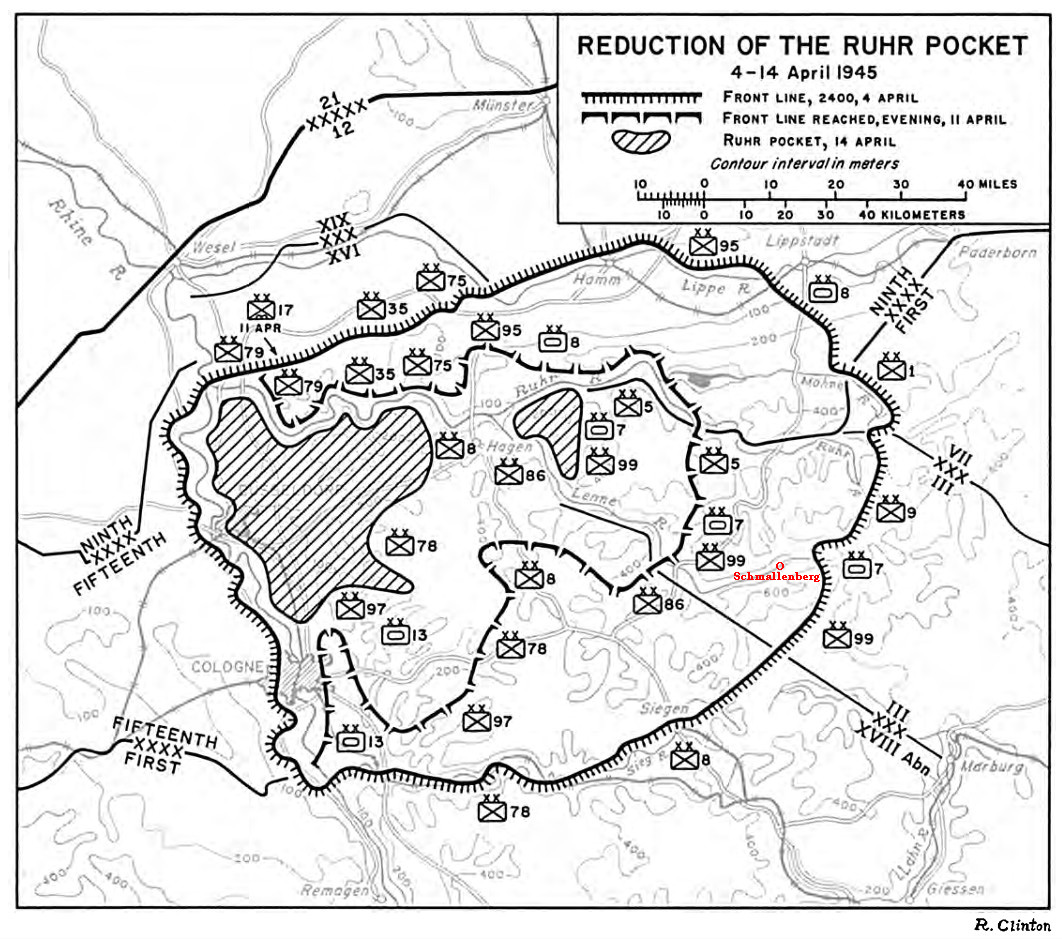
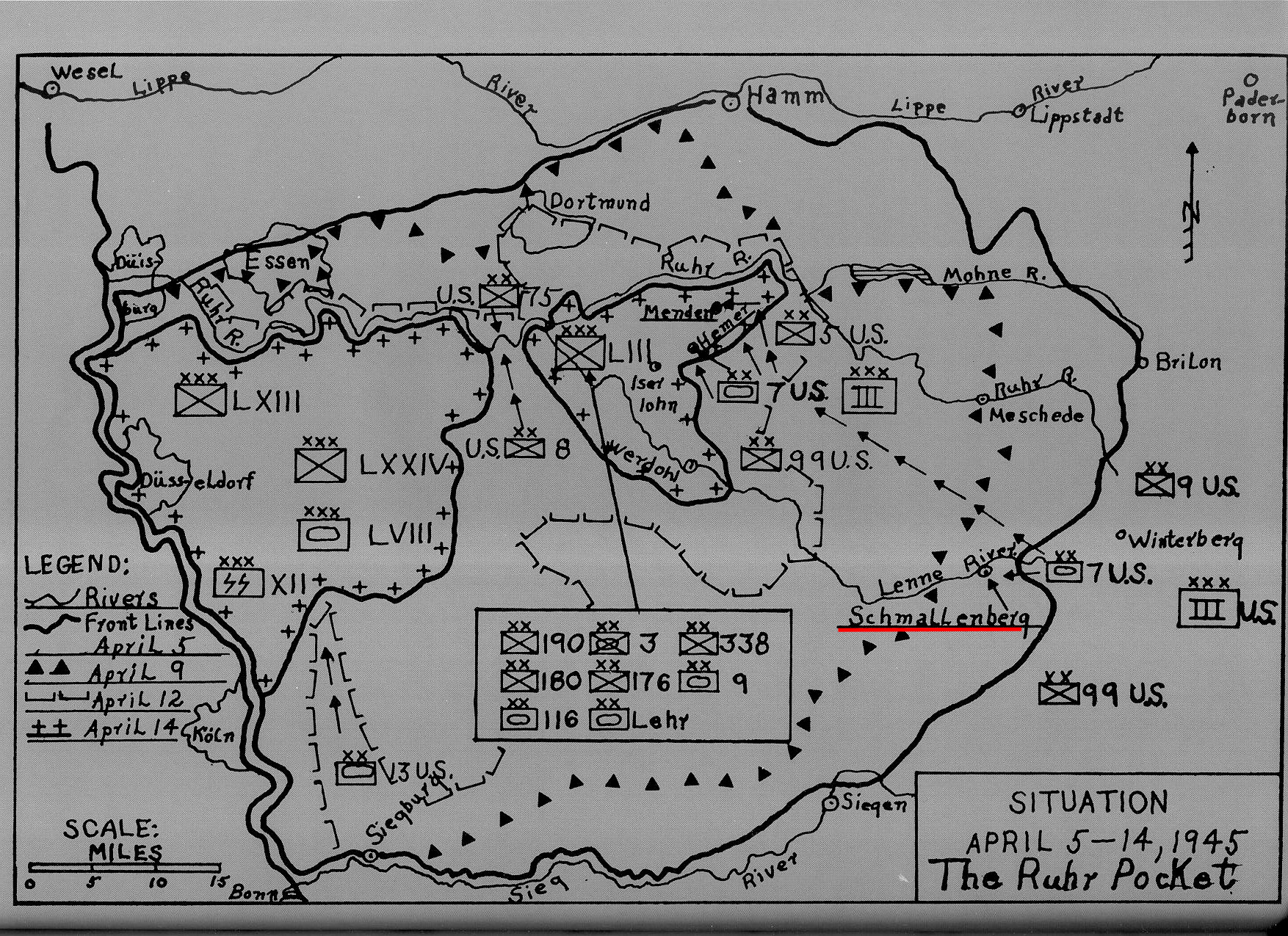
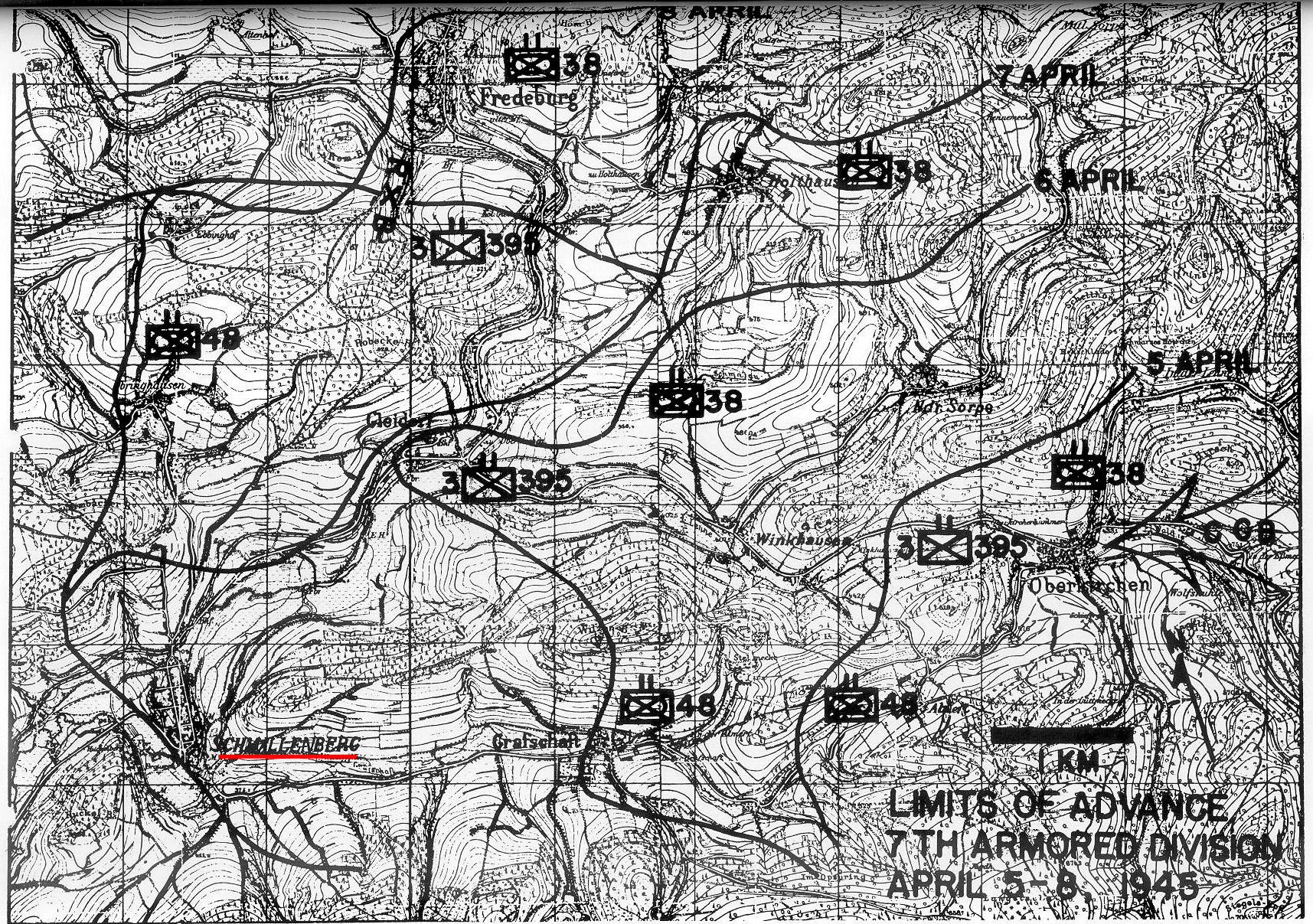
During the reduction of the Ruhr Pocket, U.S. 7th Armored Division's 48th Armored Infantry Battalion moved on 7 April 1945 from Grafschaft, Germany, to take Schmallenberg. Companies A and C made the attack, with Company B then charged with mopping up. While the attacking A/48 took the most casualties, the mopping up B/48 took nearly as many casualties as the attacking C/48. And B/48 lost twice as many men killed as the other two companies combined. Company B of 31st Tank Battalion shows them at Schmallenberg. C/31's Morning Report makes no mention of Schmallenberg, but the 31st Tank Battalion After Action Report places C/31 at Schmallenberg. So, both companies are included here. And a veteran's account says some elements of C/31 were on loan to B/31 at Schmallenberg. This web page gathers what can be found in the records and in personal accounts toward having an accurate account of what happened. This process has already identified that the official dates of death of B/48 men as 8 April instead of 7 April are incorrect and gives the source of how that error came about. |
|
The After Action Report for April 1945, dated 1 May 1945, has 19 pages comprised of the following reports.
Only those pages relevant to Schmallenberg (which was on 7 April 1945) are included here.
Main Report (p. 2)
Headquarters Company Report (p. 2) (NOTE: The dates conflict with the other reports.)
|
|
The After Action Report for April 1945, dated 2 May 1945, has 9 pages. Only those pages relevant to Schmallenberg (which was on 7 April 1945) are included here.
Page 3
|
|
The After Action Report for April 1945, dated 1 May 1945, has 7 pages. Only those pages relevant to Schmallenberg (which was on 7 April 1945) are included here.
Page 4
|
|
These original reports are among those collected in the book "The Ruhr Pocket and the Baltic Sea: 7th Armored Division Combat Interviews and After Action Report, Germany, April 1945" which is available on Amazon. The page numbers given are pages within the book and not in the original
7th Armored Division After Action Report
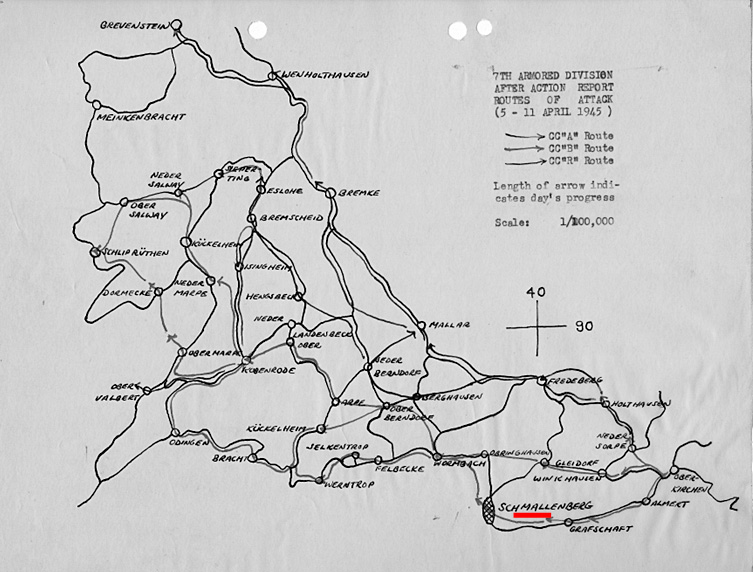
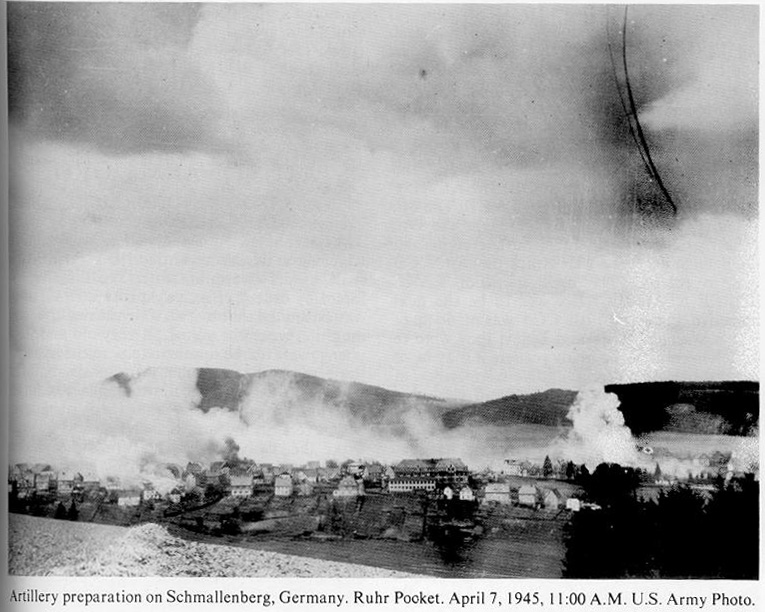
Click on image for full size. Page 73 At the end of the day [6 Apr 1945], the division's forces were on high ground to the west and northwest of SCHMALLENBERG (3884) in position to attack that town. Page 74 SUMMARY 7-APRIL Fanatical defense of every inch of the ground was again in order for 7 April. The day opened with two determined and quite sizeable counter-attacks on GLIEDORF both of which were repulsed with the enemy forces drawing northwards towards FREDEBURG. Combat Command "R" made a bitterly contested entry into HOLTHAUSEN and Combat Command "B" took SCHMALLENBERG (3884), the largest town in the area, against moderate to heavy resistance. Once inside the town, the troops were faced with the dual problem of combatting fierce resistance and poor observation caused by the smoke of buildings burning from our own artillery and air preparations. The blinding smoke concealed many weapons which continued to deliver a heavy volume of fire and the 48th Arm'd Inf. Bn., was obliged to clear the town house by house. Page 75 SCHMALLENBERG FALLS The 48th Arm'd Inf Bn., supported by B/31st Tank Bn., under Combat Command "B", maneuvered into position to attack SCHMALLENBERG from the east and southeast on 7 April. C/48th made a wide envelopment through the woods to a position south of the town while A/48th moved through the woods and stopped east of the town to coordinate its attack with "C" Company. The two companies jumped off at 1110 after two battalions of artillery had hit the town with a ten minute preparation. C/48th entering the town from the south was met with small arms and machine gun fire from the south. A/48th met withering small arms, anti-tank and self propelled gun fire as it entered the town from the east. Just prior to their entry, four P-47's had bombed and strafed SCHMALLENBERG but it was still found necessary to fight from block to block to clear the town. The Germans finally gave up after the combined assault of artillery, tanks and infantry at 1900 and 350 PW's were taken. The 87th Cav Rcn Sq Mecz., occupied SCHMALLENBERG during the night 7-8 April, relieving the 48th Arm'd Inf Bn., who pushed on to secure the high ground about 1,000 yards northwest of the town. G-2 Notes (The G-2 Officer was the Intelligence Officer in the Division's General Staff)
|
|
|
|
|
|
|
Click on image for full size. |
Click on image for full size. |
|
"They had crossed a strange line, they had become wounded men, and everybody realized, including themselves, dimly that they were now different ...They had been initiated into a strange, insane, twilight fraternity where explanation would be forever impossible. ... Tenderness was all that could be given." |
| Casualty |
|
|
|
|
|
|
| KIA or DOW |
|
 Pfc Terrence M. Coyne KIA 7 Apr Rifleman (9 Apr) Pfc Terrence M. Coyne KIA 7 Apr Rifleman (9 Apr)
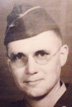 Pfc Robert E. L. Price DOW 7 Apr Rifleman (9 Apr) Pfc Robert E. L. Price DOW 7 Apr Rifleman (9 Apr)
 Pvt John G. White KIA 7 Apr Rifleman (11 Apr MIA, 20 Apr KIA) Pvt John G. White KIA 7 Apr Rifleman (11 Apr MIA, 20 Apr KIA)
|
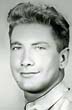 Pfc John J. Lister KIA 7 Apr Rifleman (9 Apr) Pfc John J. Lister KIA 7 Apr Rifleman (9 Apr)
|
. | . |
|
| SWA (Seriously Wounded in Action) and Survived |
|
|
|
|
|
. |
| LWA (Lightly Wounded in Action) and Survived |
|
|
|
. |
|
Sgt Vester Ashmore (7 Apr) |
| LIA (Lightly Injured in Action) and Survived |
|
. | . | . | . | . |
| MIA (Missing in Action) and Survived but no return to duty found | . |
|
. | . | . | . |
|
A/48
B/48
Pfc. William H. Grady Jr.
Pfc. John Paul Kazlauskas
Pvt. Robert E. Lee Price
Pvt. John G. White
S/Sgt. William Henry Zoellner
C/48
Pvt. Edward Dale Ralston
Pvt. Jack T. Remcus
C/31
|
|
Map of the Historic Old Town of Schmallenberg
The town is basically laid out as a long narrow town along two parallel main streets.
Brief history of Schmallenberg
Der Angriff auf Schmallenberg im April 1945 (The attack on Schmallenberg in April 1945)
On April 6, 1945, the situation in Schmallenberg escalated dramatically. German soldiers increasingly entered the town, and an assault gun was positioned at the water gate, directly in front of the Veltins family's house (today the Vollmert house). The danger was ever-present, especially for the residents of this house, who eventually fled to us. Our pleas to the gun commander to choose a different location to protect the civilian population and the wounded in the elementary school's infirmary (today the Alexanderhaus) were unsuccessful. The tank remained, and its escort sought shelter in our cellar (today the corner building at Alter Kirchplatz/Oststraße). In the early afternoon, I was preparing potatoes upstairs with one of the soldiers. The firefight outside intensified, and suddenly an explosion shattered the large window. The soldier ducked, while I was thrown against the door. I felt warm blood on my forehead. We quickly returned to the cellar, where everyone was in a state of great agitation. A grenade had exploded right on the garden wall.
The night of April 7th In the early morning of April 7th, the fighting intensified further, and all hell broke loose! Around 6:00 a.m., tank shells and artillery fire announced the arrival of the Americans. But it wasn't until shortly before noon that the shell explosions ceased; only the occasional shot broke the silence. The tank crew left our cellar, leaving only one medic behind, deliberately hoping to be taken prisoner. Later, through the open door, we saw thick plumes of smoke drifting across the church square. There was a fire, but where exactly? Suddenly, a bullet whizzed through our room. Two American soldiers had fired in the heat of the moment; luckily, they only hit the washing machine. Grabbed white cloths and shouting, "Women and children only!", we surrendered. I trembled with excitement: On April 7th, the victor of the Battle of Schmallenberg stood before us in the form of an American soldier. It was over!
A picture of horror Our hearts stopped when we stepped onto the front steps of our house: the houses and the elementary school – all burned down or gutted; the church square and the street – destroyed by direct hits; the shattered trees – war! We felt it acutely in those moments. Above the misery, a wonderful spring sky was blue, the sun was shining, the mountains stood in unshakeable solidity. The American soldiers forced us to go into the church, even though German soldiers were still firing from the tower. After negotiations with the Americans, we were able to leave the church again after a short time.
Are you still alive? At noon, he and his former staff were summoned to our house for a meeting by several American officers. The meeting was over quickly, and everyone got into a car to drive to Grafschaft to meet the commander. Not a single German returned from that journey. Gradually, we became aware that we were no longer free. Soldiers kept coming to our house, anxiously but politely searching every room. This changed, however, when they started drinking alcohol and became quite boorish in their drunkenness. Otherwise, Sunday passed quietly. The streets were empty of civilians. Only our Vicar Geisthövel kept going out to recover the dead. I believe everyone who saw him was deeply moved by the grief-stricken figure of this man. |
|
A/48 Conclusions
B/48 Conclusions
C/48 Conclusions
C/31 Conclusions
|
Active overview of all pages at the 7th Armored Division web site