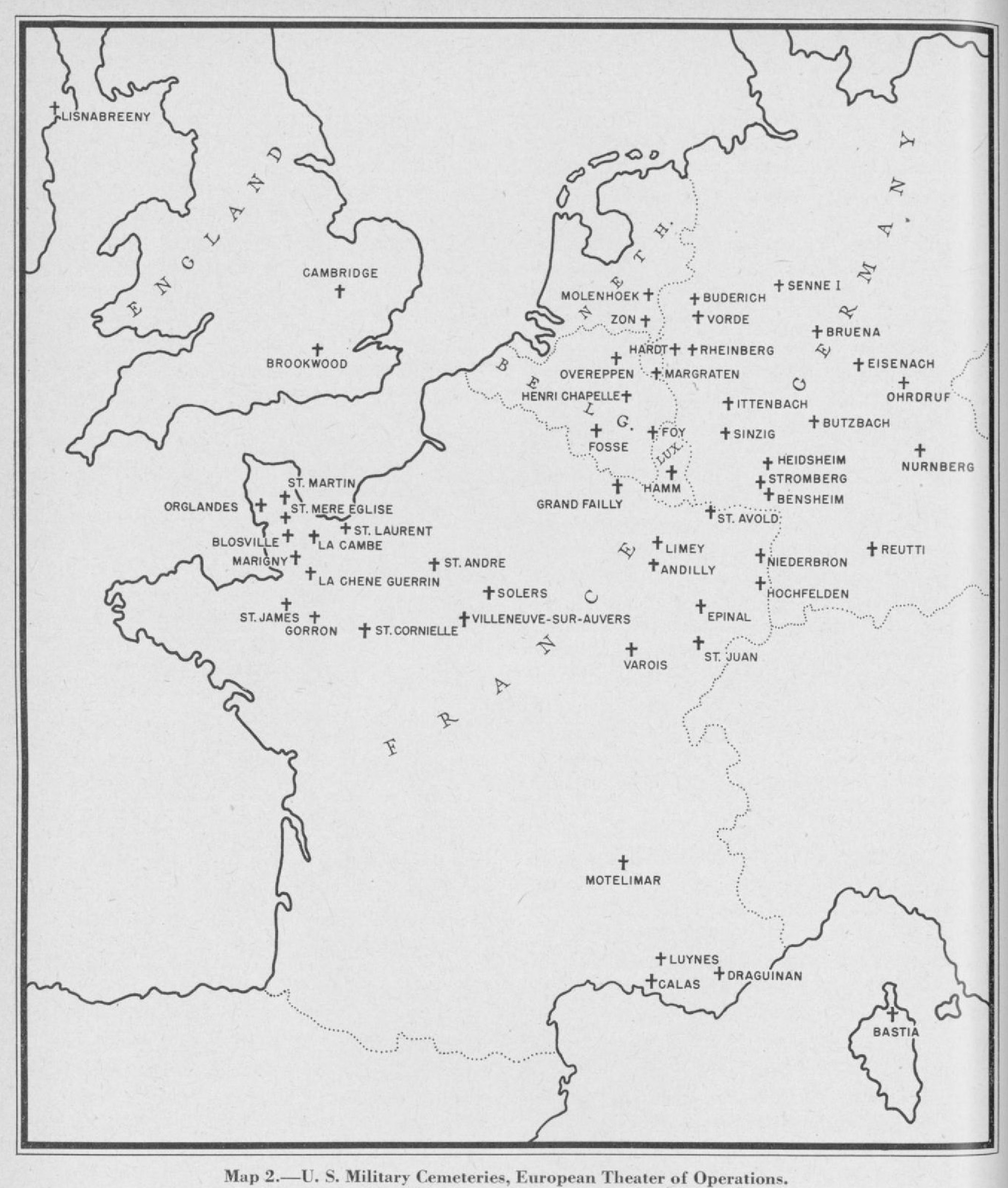
Source: "The Graves Registration Service in World War II"
(Q.M.C. Historical Studies No. 21) by Edward Steere
Note that the map does not correspond exactly with the list below.
Click on image to view full sized.
|
|
|
||||||
|
|
The American World War II Orphans Network (AWON) is an organization created by and for those who lost their father in World War II. AWON has an annual conference and a newsletter filled with useful information. Click here to go to the AWON web page and find those who share your experience. |
|
Far too many men who went to war in Europe in World War II have never been found and identified. Many have been found who have not been identified. This page is an attempt to list all of the numbers that were assigned to unknowns, as well as the associated information about where and when they were recovered and their names, if they were subsequently identified. I realized that I needed a list like this in my own research. Often, when I examine one man's IDPF, I find that he was recovered with someone who was shown only with an unknown-number (e.g. X-2319). It would be very useful in my research to know who the other man was and to obtain his IDPF and see if it has more information that can shed light on the situation in which they died. I tried to obtain one from the American Battle Monuments Commission, since the Ardennes US Military Cemetery (at Neupr -en-Condroz, Belgium) was the place where remains were sent for possible identification after the war -- and is thus the cemetery with the greatest number of burials of unknowns. However, my efforts were in vain. So I simply started a spreadsheet to record what I find in the records that I do have and began posting it on this web page, in case it is of use to others. There is also a Grave Registration Forms & Information section following the list of unknowns. This section provides bibliographical information on links to forms, documents and web sites with relevant information. This in turn grew to include the Temporary Cemeteries in the European Theater of Operations section, which has a wealth of information. One useful external tool in all this will be the American Battle Monuments Commission's World War II Honor Roll. Another important tool is the World War II Registry of the National World War II Memorial. I will reply to queries about any of the ones on this page. I'm really swamped and my health has definite limits, especially from October-May. So I will not be able to reply very promptly, and I cannot give you more information about any man who is not on this page. Having read that, if your inquiry is truly relevant to this page, you can contact me by clicking here. See the end of the page for a list of the temporary U. S. military cemeteries in the ETO and a link to the complete 1946 grave plots of the temporary Henri-Chapelle (Belgium) U. S. Military Cemetery. SCOPE OF THIS PAGE: This page systematically contains all found records of Unknowns in the European Theater of Operations. If records for an Unknown from another theater, such as the Mediterranean Theater, exist in an ETO file, then the non-ETO Unknown is included here, but this page does not systematically include non-ETO Unknowns. -- Wesley Johnston, Historian, 7th Armored Division Association |
|
Clearly one would think that there must have been a master list of all the X-numbers assigned in the European Theater. Yet, when one family of a still-missing man asked for such a list, they were told (2009) that no such list existed: "There is currently no master list of all X-numbered files for the ETO." And after having tried to find such a list at the National Archives, I see that if there is still such a list, then it is probably waiting somewhere in a non-obvious place that no one has yet found. I did find definitive evidence that such a list did in fact exist as late as 1960. In the investigation of remains X-9345 (Frankfurt Mausoleum), there was a need to find information about another X-number, and the investigators documented that they had sought that X-number in "Roster in Disposition Branch showing disposition of Unknown X-Nos. (remains)". So there clearly was just such a list. So the question remains "Where is the official roster of Unknown X-numbers?" In addition to the full list below, which includes Unknowns now identified and those not yet identified, I have begun creating separate pages for the still-unidentified ETO Unknowns, grouped by the cemetery at which they were either first recovered or to which they were transferred (and their X-number possibly re-designated at the receiving cemetery).
|
"
"
"
"
|
Grave not Graves? - Those familiar with the U. S. Graves Registration Service may feel some tension to read "Grave Registration" on this section. The tension is intended. The use of "Grave" is intended. We should never forget that every single grave contains the story of (at least) one man (or in rare cases in WWII one woman) -- his hopes, his family, his childhood, the future he never had. "Graves" only happen one at a time as a "Grave" is made for a service member who died. So the use of "Grave" here is to focus on this. Forms for Remains The transport, recovery, burial, identification and final disposition of remains generated many different printed forms - so many that they require their own web page. Click here for my web page presenting all of the forms I have encountered. Manuals
ETO Burial Reports
Online Resources
British Records
|
|
An asterisk (*) indicates those cemeteries that later became permanent, although these were completely redesigned cemteries, which required the complete disinterrment of all remains in the temporary cemetery. The number in square brackets is the Army-assigned code for the cemetery. Click here for a document listing all codes (thanks to Ted Darcy). I have NOT attempted to cross-reference all of the ETO Burial Reports in the previous section. These have records of many of the ETO cemeteries. So, be sure to look at those records as well to see what they have on any given cemetery. In particular, the link in that section above also has an exhaustive study on the identification of those buried at the Grand Failly cemetery. |
|
|